Renting out real estate can build generational wealth, but hidden overhead often turns an expected cash cow into a quiet financial drain. You can determine whether your property actually builds net worth or quietly bleeds your personal bank account dry by evaluating eight specific operational red flags. When maintenance spikes, insurance premiums climb, and unexpected vacancies stretch past local benchmarks, your rental property is losing money—leaving you to subsidize tenant living expenses with your household paycheck. Auditing your true cash flow reveals whether being a landlord is worth it or if selling the asset creates a faster path toward financial security and personal peace of mind.

The Hidden Costs of Being a Landlord in Today’s Market
Many property owners enter real estate expecting predictable monthly cash flow, only to watch rising systemic overhead devour their margins. The financial reality of managing rental property has shifted dramatically over recent years. Between escalating local property taxes, rising contractor rates, and persistent inflation on building supplies, everyday landlord expenses vs rental income ratios have tightened significantly across the nation. Many middle-income households who became accidental landlords by renting out a previous primary residence now find that gross rent checks barely cover basic upkeep and municipal tax hikes.
Recent economic metrics reveal mounting pressure on individual property owners. According to Federal Reserve financial data, real property insurance costs for apartment buildings jumped over 75 percent between 2019 and 2024, climbing from $39 per unit per month to $68 per unit per month. Meanwhile, industry standards show that residential landlords routinely spend between 25 percent and 45 percent of their gross rental income on operating expenses alone—before paying a single dollar toward their mortgage principal or interest. If you do not track every dollar leaving your operational account, subtle fee increases will quietly convert a profitable real estate investment into a costly personal liability.
8 Signs Your Rental Property Is Losing Money
1. Your Operating Expense Ratio Exceeds 45 Percent
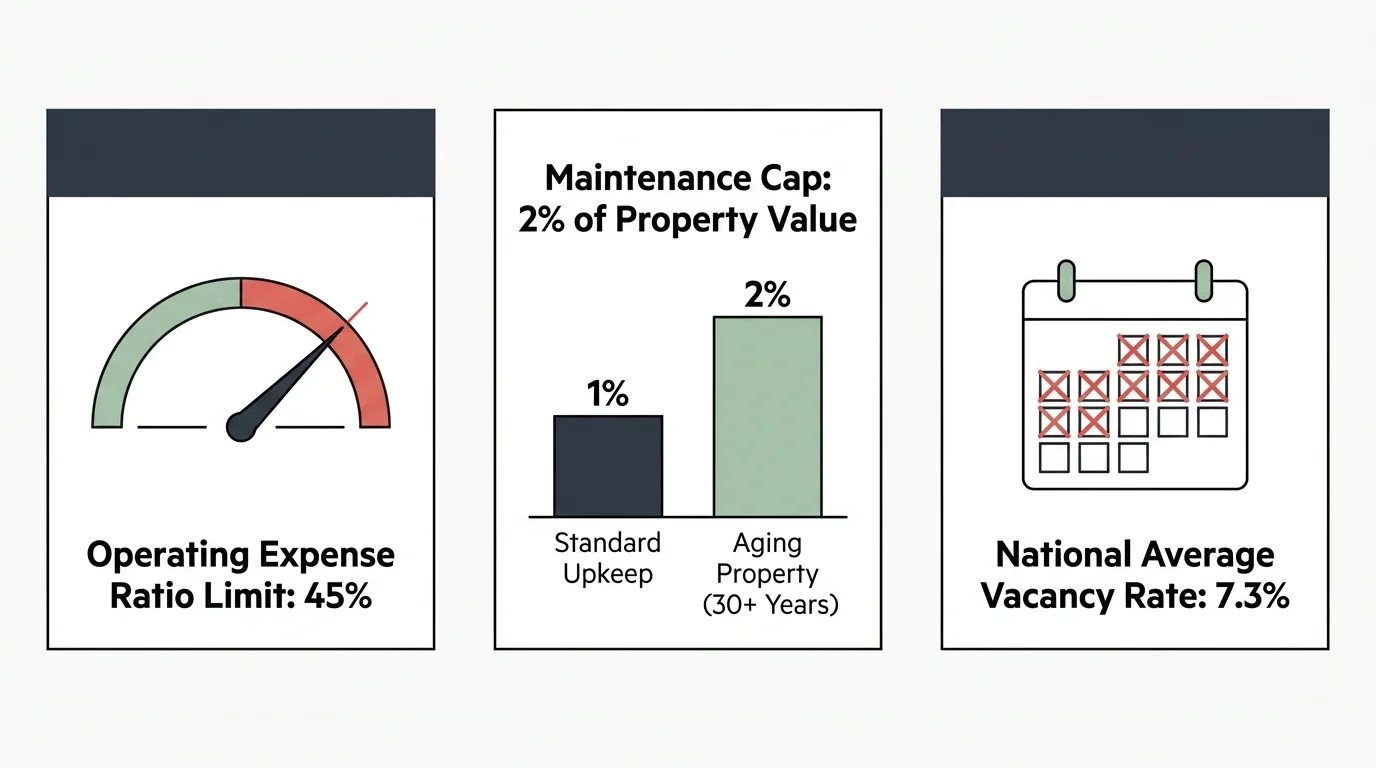
Your operating expense ratio measures total operational costs against total gross rental revenue. Standard benchmark guidelines suggest keeping non-mortgage operational expenses between 25 percent and 45 percent of your total collected rent. When routine bills—such as property taxes, landlord insurance, routine repairs, HOA dues, and utility coverage—consistently absorb more than 45 percent of your top-line revenue, your margin for error vanishes. A high expense ratio means that even a minor unexpected repair will force you to dip into your personal paycheck to keep the property running smoothly.
2. Maintenance Costs Swallowing 2 Percent or More of Property Value
Financial planners generally recommend budgeting 1 percent of your home’s total replacement value annually for standard upkeep. However, aging properties demand a much steeper financial commitment. For properties older than 30 years, aging HVAC systems, deteriorating roofs, and outdated plumbing drive annual maintenance costs up to 1.5 percent or 2 percent of total property value. If your $300,000 single-family rental demands $6,000 or more every year just to remain habitable, repair costs are eating directly into your principal growth and eliminating net cash flow.
3. Holding Costs During Vacancies Drag Out Past Market Averages
An empty property produces zero revenue while generating continuous expenses, including mortgage payments, property taxes, utilities, and landlord insurance. Data published by the U.S. Census Bureau housing data reports a national rental vacancy rate of 7.3 percent in early 2026. If your property remains vacant for longer than four to six weeks between tenants, your annual gross yield drops significantly. Prolonged vacancies usually signal flawed pricing strategies, poor physical condition, or inadequate local advertising, all of which compromise profitability.
4. Insurance Premiums Outpacing Rental Rate Hikes
Landlord insurance policies carry unique liability protections and tenant-turnover risks, causing them to cost 15 percent to 25 percent more than traditional owner-occupied homeowners policies on the exact same structure. Annual premiums for single-family rentals currently average between $800 and $2,500 depending on region and risk factors. When property insurance premiums surge by double-digit percentages annually while regional tenant lease caps prevent you from raising rents proportionally, your net margin shrinks. Over time, insurance creep turns positive cash flow into negative net income.
5. Property Management Fees Erase Your Remaining Net Income
Hiring professional management saves valuable time, but standard property management fees absorb 8 percent to 12 percent of gross monthly rental income. Furthermore, management agencies often charge lease-up fees equal to 50 percent to 100 percent of one month’s rent whenever they place a new tenant. If your rental property delivers a tight 5 percent cash-on-cash margin, paying a management company 10 percent off the top pushes your balance sheet into negative territory; you are effectively paying a third party to manage a loss-making asset.
6. Unexpected Capital Expenditures Force You to Borrow Money
Routine maintenance covers minor fixes like leaking faucets or running toilets, but capital expenditures involve replacing major structural assets like roofs, water heaters, and furnace units. If a $9,000 HVAC replacement forces you to rely on high-interest credit cards or personal loans, your rental property lacks sufficient capital reserves. Financial guidance from the Consumer Financial Protection Bureau guidance highlights how carrying high-cost revolving debt erodes long-term wealth—meaning your real estate investment is actively compromising your broader household balance sheet.
7. Tenant Delinquency and Eviction Losses Spill Into Personal Savings
Non-paying tenants present one of the most acute financial threats to private landlords. Direct legal fees and court enforcement for an eviction cost an average of $3,500 per proceeding. When you factor in multiple months of unpaid rent, legal representation, court filing fees, and physical repair costs after tenant move-out, total average eviction losses exceed $6,400 per incident. If a single bad tenant forces you to draw cash from your family’s personal emergency fund, your rental property is exposing your home finances to unacceptable risk.
8. Your Time-Adjusted Return Falls Below High-Yield Benchmarks
Evaluating whether renting out property is profitable requires auditing both your capital and your personal labor. If your rental property generates $2,000 in annual net cash flow, but you spend 100 hours managing tenant complaints, coordinating contractors, and chasing late payments, your personal labor yields just $20 per hour. When you compare that active labor against passive investment alternatives—such as broad-market index funds or liquid high-yield savings accounts—the real estate asset may yield a lower risk-adjusted return while generating substantial physical and emotional stress.

Action Lab: Performing a True Cash-Flow Audit on Your Property
To determine if being a landlord is worth it, you must execute a comprehensive cash-flow audit using real numbers rather than initial projections. Start by compiling twelve full months of property records, bank statements, and tax forms. Calculate your true annual gross income by adding all collected rental payments, late fees, and utility reimbursements, then subtract every operational outlay experienced over that same twelve-month window.
Consider a practical scenario involving a single-family rental house valued at $300,000 with a monthly rent charge of $2,000, yielding $24,000 in gross annual income. Your annual mortgage principal and interest total $12,000. Property taxes consume $3,200 annually, while landlord insurance costs $1,800. Routine maintenance on this 35-year-old property averages 1.5 percent of home value, totaling $4,500. Accounting for the national average vacancy rate of 7.3 percent adds $1,752 in annual holding losses, and professional management fees at 10 percent absorb $2,400.
When you total these operational expenses—$3,200 for taxes, $1,800 for insurance, $4,500 for maintenance, $1,752 for vacancy, and $2,400 for management—your non-mortgage operational costs equal $13,652 annually. Subtracting operating expenses from your $24,000 gross revenue leaves a Net Operating Income of $10,348. Once you deduct your $12,000 annual mortgage payment, your real cash flow stands at negative $1,652 per year. Despite collecting $2,000 every month, you are actually losing $137 each month.
Calculating your Cash-on-Cash Return reveals the deeper truth. If you invested $60,000 in cash down payment and closing costs to acquire this property, dividing your negative $1,652 annual cash flow by your $60,000 invested capital yields a negative 2.75 percent cash-on-cash return. Performing this simple audit prevents hidden expenses from masking real operational losses.

Strategic Guardrails: Avoiding Common Financial Pitfalls
Protecting your household wealth requires establishing firm operational guardrails before real estate losses compound. First, establish a separate, dedicated bank account for all property revenues and expenses; commingling personal funds with rental cash flow obscures underlying financial performance. Maintain a dedicated reserve fund holding at least six months of mortgage payments plus 5 percent of property value to absorb capital expenditures without borrowing money.
Avoid keeping rental rates significantly below local market averages simply to avoid tenant turnover. While long-term tenants offer stability, artificially low rents fail to offset real baseline cost increases in insurance, maintenance, and municipal property taxes. Review localized market rent reports from reputable research firms such as U.S. Department of Housing and Urban Development datasets annually, ensuring your rent adjustments keep pace with inflation while maintaining fair market standards.
Additionally, consult a tax professional to evaluate how depreciation recapture and capital gains taxes will impact your net proceeds if you decide to exit. Understanding the tax consequences before putting up a sale sign ensures you execute a clean exit strategy that preserves maximum equity.
Frequently Asked Questions
Is being a landlord worth it if my property breaks even every month?
Breaking even on monthly cash flow leaves your portfolio vulnerable to market fluctuations and unexpected repair bills. While equity growth through mortgage paydown builds net worth over decades, zero monthly cash flow forces you to cover sudden capital expenses out of pocket. A healthy investment property should yield positive operational cash flow alongside long-term principal reduction.
How do I decide whether to raise the rent or sell the property?
Calculate your current cash-on-cash return and compare it to local rent growth metrics. If raising rent to market rate brings your operating expense ratio back below 45 percent without increasing vacancy risk, keeping the property makes financial sense. However, if structural maintenance costs or rising property taxes outpace regional wage growth, selling the asset and reallocating equity into alternative investments protects capital.
How much cash reserve should I maintain for a single-family rental?
Financial planners recommend holding three to six months of total operating expenses—including mortgage, property taxes, and insurance—plus an additional $5,000 cap-ex emergency reserve per property. This capital cushion ensures that major system failures like roof leaks or furnace replacements do not force you to rely on personal credit cards.
Can I convert my landlord policy to standard homeowners insurance to save money?
No, switching to standard homeowners insurance on a tenant-occupied property compromises your coverage entirely. Insurers require landlord policies because tenant-occupied structures carry distinct liability, liability claims, and rental loss risks; filing a claim under an incorrect policy type gives insurance carriers legal grounds to deny your claim entirely.
Take Control of Your Real Estate Financial Future
Managing rental property should serve your family’s long-term financial security rather than drains your monthly bank account. Take action tonight by reviewing your past twelve months of property income and operational expenses. Execute a clear cash-flow audit, evaluate your operating expense ratio, and determine whether your asset yields positive returns for your time and capital. If your analysis shows consistent negative cash flow, establish a timeline to adjust rents, restructure expenses, or sell the property. Reclaiming your capital and peace of mind empowers you to make proactive financial decisions that truly build lasting wealth.