Receiving a life insurance payout offers vital financial protection during a difficult emotional transition, yet navigating the accompanying tax regulations often creates unnecessary stress for surviving family members. Understanding life insurance payout tax rules guarantees that you protect your family’s inheritance while optimizing every dollar to stretch your household budget. Under primary federal tax guidelines, most lump-sum death benefits arrive completely free from federal income tax, providing immediate liquidity when your family needs it most. However, specific payout structures, deferred interest payments, and policy ownership arrangements can trigger unexpected tax liabilities. By mastering these core tax principles today, you can confidently manage incoming policy proceeds, preserve your financial stability, and avoid costly IRS reporting mistakes.

Understanding the General Exclusion on Lump-Sum Proceeds
The primary rule governing life insurance death benefits works heavily in your favor. Under Section 101(a) of the Internal Revenue Code, when an insurance company disburses proceeds in a single lump sum directly to a designated beneficiary, the federal government completely excludes those funds from gross income. You do not pay federal income tax on the principal amount, nor do you report the initial benefit as taxable income on your tax return. Referencing official Internal Revenue Service guidelines on insurance proceeds confirms that this tax exclusion applies to both modest individual term contracts and substantial permanent insurance policies.
For middle-income households managing tight budgets, this tax-free treatment provides an invaluable financial buffer. When you receive a death benefit check, every dollar goes directly toward your family’s immediate needs, such as settling remaining debts, funding future educational costs, or maintaining monthly lifestyle expenses. Because the payment does not increase your adjusted gross income, it will not push you into a higher marginal tax bracket or trigger phase-outs for valuable federal tax credits. Understanding this core protection empowers you to make clear, deliberate financial decisions without fearing a surprising tax bill at year-end.

When Payouts Become Taxable: Interest, Installments, and Annuities
While the core death benefit arrives tax-free, secondary earnings generated by policy proceeds fall under different rules. If you leave the death benefit with the insurance carrier for an extended period, or if the insurer delays disbursement, any interest earned on the principal balance becomes fully taxable income.
Interest Growth on Retained Accounts
Insurance companies frequently offer to hold lump-sum proceeds in specialized interest-bearing accounts. While these accounts give you time to evaluate your financial priorities, the growth generated inside the account does not share the death benefit’s tax-exempt status. Any accumulated interest represents taxable income in the eyes of the law. You must report this interest on line 2b of Form 1040, paying ordinary income tax rates on those earnings. Accessing Consumer Financial Protection Bureau financial planning resources can help you evaluate whether holding funds in insurer accounts aligns with your cash-flow strategy.
Annuities and Installment Payment Options
Selecting a multi-year installment schedule or an annuity payout option rather than a single lump sum introduces partial taxability. Each installment payment you receive comprises two distinct components: a tax-free return of the original death benefit principal and a taxable portion representing interest generated over time. At year-end, the insurer distributes IRS Form 1099-R or Form 1099-INT detailing the precise breakdown, allowing you to accurately report taxable interest without guesswork.

Estate Tax Rules and Policy Ownership Nuances
Although most beneficiaries easily avoid income taxes on death benefits, estate taxes present a separate legal framework. The IRS includes life insurance proceeds in the deceased individual’s gross estate if the deceased held specific legal rights over the policy at the time of their death. These rights, known as incidents of ownership, dictate whether policy proceeds count toward federal estate tax thresholds.
Understanding Federal Estate Tax Thresholds
Federal estate tax thresholds remain exceptionally high for most American families. For individuals passing away in 2025, the federal estate tax exemption stands at $13.99 million per individual, or $27.98 million for married couples. In 2026, this exemption threshold rises to $15.00 million per individual, or $30.00 million for married couples who elect portability on IRS Form 706. According to recent Federal Reserve economic research on household wealth, the vast majority of middle-class estates fall well below these thresholds, meaning very few beneficiaries ever owe federal estate taxes on life insurance payouts.
Incidents of Ownership and Transfer Rules
If the deceased person owned the policy, held the right to change beneficiaries, borrowed against cash value, or possessed authority to pledge the contract as collateral, they maintained incidents of ownership. In those cases, the full payout merges with their gross estate for tax calculations. To keep large policies outside a taxable estate, some individuals transfer ownership to another person or an Irrevocable Life Insurance Trust.
The IRS Three-Year Lookback Rule
When transferring policy ownership to lower potential estate taxes, timing becomes critical under Section 2035 of the Internal Revenue Code. If a policyholder transfers contract ownership to a beneficiary or an irrevocable trust and dies within three years of that transfer, the IRS voids the transfer for tax calculation purposes. Consequently, the complete death benefit gets pulled right back into the deceased’s gross estate, potentially triggering estate taxes if total assets exceed federal thresholds.
Employer-Provided Group Term Life Insurance Tax Distinctions
Many employees secure affordable life insurance coverage through workplace benefit packages. Understanding how the IRS handles group term life insurance ensures you maximize workplace perks while avoiding unexpected tax surprises on your annual tax forms.
The Fifty Thousand Dollar Exemption Threshold
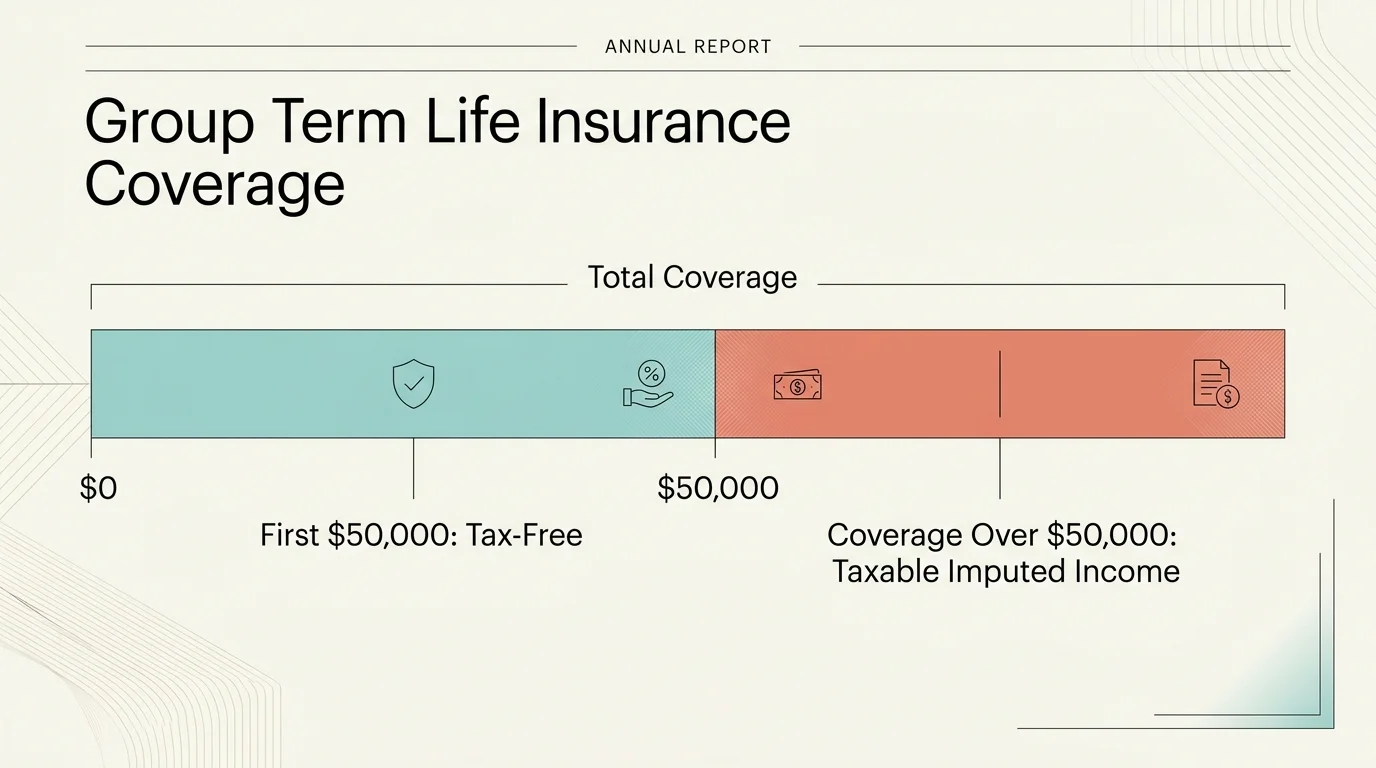
Under current tax regulations, your employer can provide up to $50,000 of group term life insurance coverage as a completely tax-free benefit. You pay no income tax on the value of this basic coverage, and your employer deducts the premiums as a business expense. Data from the Bureau of Labor Statistics employee benefits survey shows that group life insurance remains one of the most widely offered non-wage benefits across American workplaces.
Imputed Income on Excess Coverage
If your employer provides group term coverage exceeding $50,000, the IRS considers the cost of that excess coverage to be taxable imputed income. The IRS calculates this value using uniform premium tables based on age, and your employer adds this amount to your annual W-2 Form as taxable wages. However, you must distinguish between annual payroll taxation and beneficiary payout rules: even if you pay imputed income tax on excess coverage while working, your designated beneficiary still receives the entire final death benefit completely free from federal income tax.

Action Lab: Calculating Taxes on Payout Scenarios
To clarify how these tax rules apply in real life, consider a clear practical scenario. Imagine a beneficiary named Sarah who receives a $300,000 policy payout following the death of a parent. Sarah earns $65,000 annually in standard salary, placing her comfortably in a mid-range federal income tax bracket. She must decide how to handle the incoming life insurance proceeds.
In the first path, Sarah chooses an immediate lump-sum distribution. The insurance company transfers $300,000 directly to her personal checking account. Because federal tax law excludes lump-sum death benefits from gross income, Sarah pays zero dollars in federal or state income tax on the payment. Her taxable income for the year remains $65,000, leaving her overall financial strategy unburdened by extra tax liabilities.
In the second path, Sarah elects to leave $300,000 in an interest-bearing account managed by the insurer while she plans her investments. Over twelve months, the account accrues 4.0% interest, yielding $12,000 in earnings. At year-end, the insurer sends Sarah a Form 1099-INT showing $12,000 of interest. The original $300,000 principal remains tax-free, but Sarah adds $12,000 of interest to her reported income, paying ordinary income tax only on those growth earnings.

Common Beneficiary Pitfalls and How to Avoid Them
Avoiding structural mistakes ensures that your family receives insurance proceeds smoothly without exposing cash to unnecessary taxation, legal delays, or creditor claims.
The Mistake of Naming Your Estate as Beneficiary
Designating your general estate as the primary beneficiary of a life insurance policy creates significant administrative hurdles. When policy proceeds flow into an estate rather than directly to a named individual, the money must pass through probate court. Probate exposes proceeds to court costs, attorney fees, and public record disclosures. Furthermore, probate subjects cash to claims from outstanding creditors before your heirs receive anything. Naming specific individuals guarantees direct, private, and rapid distribution.
The Three-Party Goodman Triangle Trap
A lesser-known tax hazard occurs when three different people occupy the roles of policy owner, insured individual, and beneficiary. Known as the Goodman Triangle, this setup triggers taxable gift implications. For example, if a wife owns a life insurance policy on her husband’s life but names their adult daughter as beneficiary, the IRS treats the final death benefit payout as a taxable gift from the wife to the daughter upon the husband’s death. Aligning policy ownership and beneficiary designations eliminates this gift tax trap.
Overlooking State-Specific Tax Obligations
While federal income tax exemptions protect lump-sum payouts nationwide, state tax regulations vary significantly. A small group of states levy separate state-level estate taxes or inheritance taxes with exemption thresholds far lower than federal limits. While an inheritance tax falls on the beneficiary receiving the money, state estate taxes target the deceased person’s overall assets. Reviewing local tax statutes or consulting a tax accountant protects you from surprising regional tax obligations.
Frequently Asked Questions About Life Insurance Taxes
Are life insurance death benefits subject to state income taxes?
In virtually all jurisdictions, state tax codes mirror federal rules regarding life insurance death benefits. If a lump-sum payout qualifies for federal income tax exclusion under Internal Revenue Code Section 101(a), state revenue agencies also exclude the core principal from state income tax obligations. However, any taxable interest earned on delayed distributions remains subject to state income taxation.
How do I report a life insurance death benefit on my annual tax return?
If you receive a direct lump-sum death benefit with no interest accrued, you do not need to report the payout on your federal Form 1040. Because the money is fully excluded from gross income, no reporting line exists for tax-exempt proceeds. However, if you receive a Form 1099-INT or Form 1099-R showing interest earnings or annuity growth, you must report those specific numbers on designated tax lines.
Does receiving a life insurance payout affect my financial aid or government benefits?
A tax-free lump sum does not increase your adjusted gross income, preserving income-based benefits such as health insurance premium credits under the Affordable Care Act. However, holding large cash sums in bank accounts can affect asset-based eligibility tests for programs like Medicaid or college financial aid applications via the FAFSA system. Moving cash into protected assets or trusts mitigates these impacts.
What happens if a policy cash value is paid out during the policyholder’s lifetime?
Surrendering a permanent life insurance policy for cash during your lifetime follows different rules than death benefit payouts. If you surrender a cash-value policy, any amount received above your total paid premiums counts as taxable ordinary income. Borrowing against policy cash value via a policy loan remains tax-free, provided the policy stays active and does not lapse.
Take Control of Your Family’s Financial Future
Navigating life insurance payout tax rules does not require an advanced accounting degree, but it does demand proactive attention and clear organization. By recognizing that lump-sum principal benefits arrive tax-free while secondary interest earnings incur ordinary income tax, you gain complete clarity over your household cash flow. Take time this evening to audit your current family policies, double-check designated beneficiaries, and confirm that your overall coverage matches your long-term goals. Securing your legacy and protecting your hard-earned funds ensures that your loved ones enjoy financial confidence for generations to come.