
You do not need millions in savings to enjoy a comfortable, stress-free retirement. Moving to the right zip code can instantly double your purchasing power while preserving your standard of living.
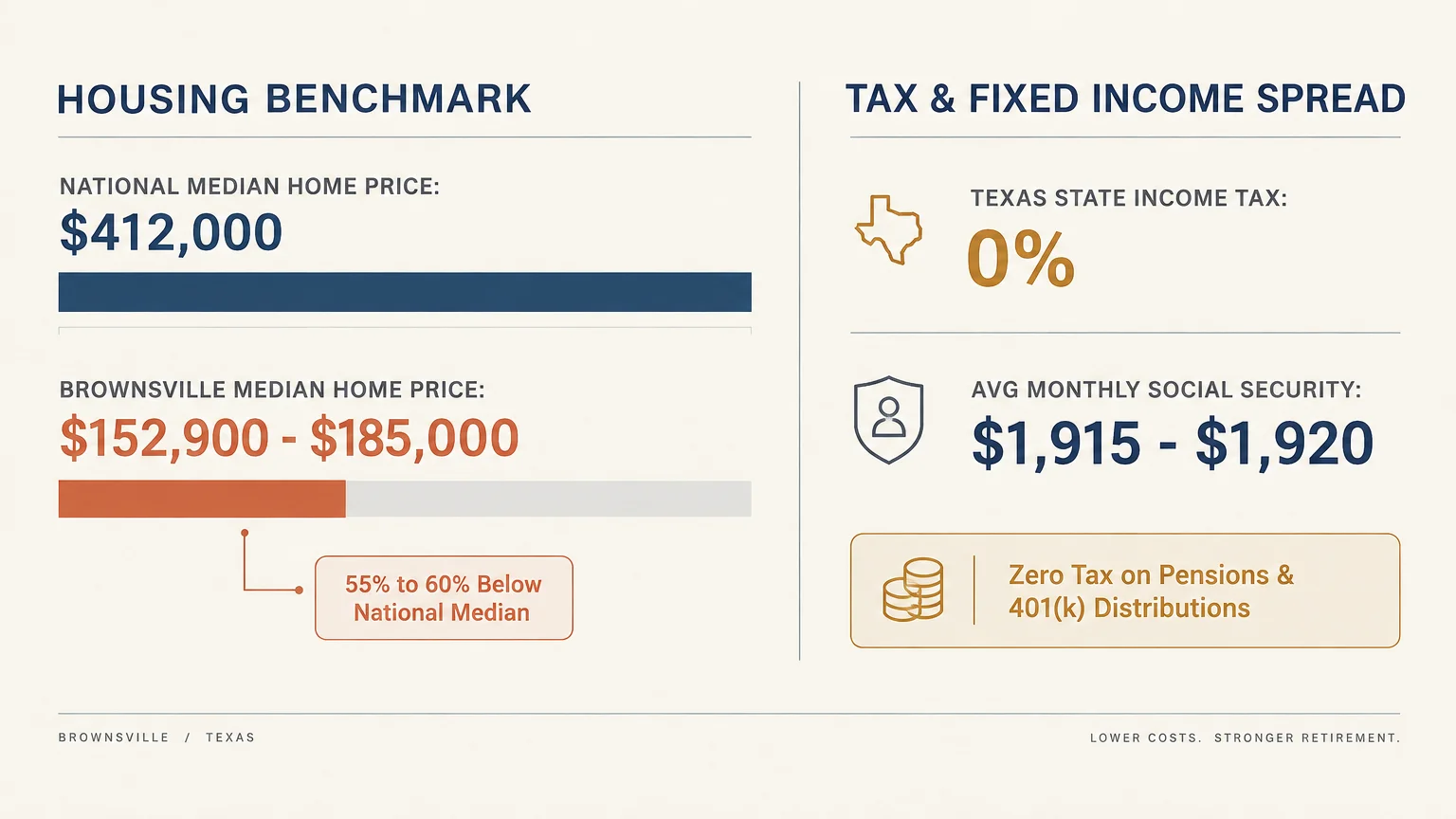
The national median home price sits above $412,000, putting intense pressure on fixed budgets. Fortunately, targeted low-cost markets allow you to purchase high-quality housing for less than half that figure.
Savvy retirees stretch their monthly checks by ditching overpriced metropolitan centers for affordable retirement towns. These five proven communities let your nest egg deliver twice the mileage without sacrificing comfort.
Tip #1: Brownsville, Texas
Deep South Living at Half the Price
Brownsville sits at the southern tip of Texas along the fertile Rio Grande Valley. It offers warm subtropical weather and easy access to the Gulf of Mexico without coastal price markups.
Housing expenses in Brownsville remain remarkably low compared to the rest of the nation. The local median home price ranges from $152,900 to $185,000, roughly 55 to 60 percent below national averages.
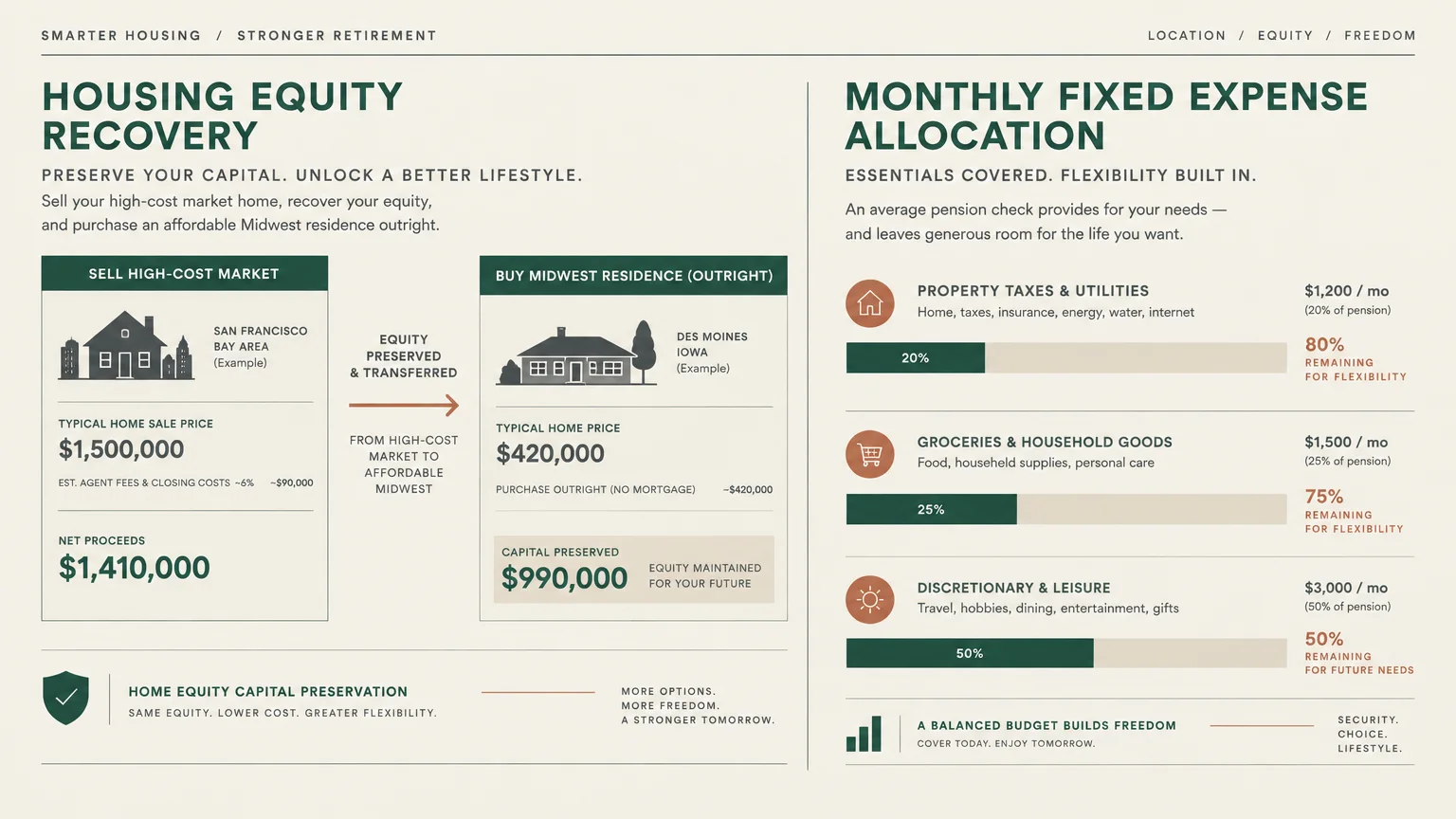
Downsizing into this market allows you to sell an expensive home elsewhere and buy outright in cash. Eliminating a monthly mortgage payment immediately frees up substantial cash flow for everyday retirement living.
Massive Tax and Everyday Savings
The overall cost of living in Brownsville sits approximately 20 to 25 percent below national benchmarks. Routine expenses like groceries, public utilities, and transportation cost significantly less than in competing Sunbelt destinations.
Texas imposes zero percent state personal income tax on its residents. You keep every cent of your Social Security benefits, pension payouts, 401(k) distributions, and traditional IRA withdrawals.
The average monthly Social Security benefit currently pays between $1,915 and $1,920. In Brownsville, that monthly check easily covers baseline housing and groceries for a frugal retiree.
Settling in proven low cost of living towns allows you to preserve your principal while maintaining independence. Your fixed income delivers comfortable breathing room rather than constant budgetary strain.
Tackling the Healthcare Burden
Fidelity Investments estimates that an average 65-year-old retiring today will need roughly $165,000 to $172,000 just for healthcare. Healthcare rates in the Rio Grande Valley rank among the nation’s lowest.
Local clinics and regional hospital systems deliver attentive medical care at deeply discounted prices. You stretch your medical nest egg further without compromising your overall health or wellness.
Retirees often flock to Florida for warm weather, only to get hammered by runaway property insurance premiums. Brownsville offers similar coastal sunshine while protecting your bank balance from extreme insurance spikes.
You can spend your mornings walking the nature trails at Resaca de la Palma State Park. In the afternoon, you can relax along the sandy beaches of South Padre Island.
Regional agricultural hubs provide cheap fresh fruits and vegetables to local grocery markets all year long. Slashing your grocery bills each week shields your wallet against ongoing retail inflation.
Choosing Brownsville proves that you never have to forfeit warm weather to secure affordable retirement living. It turns an ordinary pension into a durable, self-sustaining financial safety net.

Tip #2: Poplar Bluff, Missouri
Ozark Foothills and Ultra-Low Overhead
Poplar Bluff nestles in the scenic foothills of the Missouri Ozarks. It combines small-town community charm with vital regional commercial and medical resources.
A recent MoneyLion study ranked Poplar Bluff among the safest and most affordable retirement towns in America. The community boasts an average annual cost of living of just $33,547.
Local real estate presents an exceptional bargain for incoming retirees looking to stretch their dollars. Median home prices range between $135,000 and $150,000, well under half the national median price.
Downsizing into this market frees up substantial liquid equity from your previous primary residence. You can reinvest those proceeds into reliable dividend-paying funds rather than paying hefty property taxes.
A Groundbreaking State Tax Exemption
Missouri passed historic tax legislation that took effect on January 1, 2024. The state completely eliminated income taxes on Social Security retirement benefits for residents aged 62 and older.
The new law removed all prior income caps and deduction phase-out limits. Every single dollar of your Social Security benefit now stays directly in your pocket, free from state-level tax cuts.
Combining tax-free benefits with sub-$150,000 housing produces immense compounding savings. A retired couple receiving average benefits collects roughly $3,840 each month, easily surpassing the town’s baseline cost of living.
That predictable cash flow easily covers local mortgage payments, utilities, and grocery bills with plenty to spare. You add to your savings every month rather than worrying about running out of cash.
Outdoor Recreation and Quality Services
Outdoor recreation is abundant and virtually free throughout the Poplar Bluff region. The nearby Mark Twain National Forest and Black River offer world-class hiking, canoeing, and freshwater fishing.
You can enjoy an active outdoor retirement without paying expensive private club membership fees. Pristine public lands provide endless entertainment right in your own backyard.
Healthcare access is another major strength for local seniors. The city hosts the John J. Pershing VA Medical Center alongside comprehensive regional hospital facilities.
You receive attentive medical treatment without facing the congested waiting rooms of large metropolitan centers. Low municipal utility rates further reduce overhead, keeping your monthly bills stable throughout the year.
Poplar Bluff provides a peaceful haven for retirees who prioritize financial security and outdoor recreation. Your money works twice as hard when essential living expenses drop this low.

Tip #3: Erie, Pennsylvania
Freshwater Coastline at Bargain Rates
Erie rests along the freshwater shores of Lake Erie in northwestern Pennsylvania. It offers genuine lakefront living, sandy beaches, and vibrant maritime sunsets without luxury coastal price tags.
Most coastal waterfront towns in America demand exorbitant luxury pricing that excludes average retirees. Erie defies that trend by maintaining a median home sale price of approximately $193,250.
The city’s overall cost of living registers at 19.2 percent below the national average. If you prefer renting over homeownership, local median rents hover around an affordable $808 per month.
Erie ranks among the best value retirement towns because it combines freshwater recreation with dirt-cheap real estate. You can live near the water without liquidating your entire retirement portfolio.
The Keystone State Tax Sanctuary
Pennsylvania imposes a flat 3.07 percent personal income tax on wage earners. However, the state completely exempts retirement income for residents aged 60 and older.
This full exemption covers your Social Security payments, traditional IRA withdrawals, and 401(k) distributions. It also protects both private corporate pensions and public government retirement checks.
Retirees moving across state lines from high-tax neighbors like New York or New Jersey experience an immediate financial windfall. You retain thousands of extra dollars every year simply by changing your residency.
Those accumulated tax savings provide valuable insulation against unforeseen household expenses. You keep more money compounding in your private accounts rather than remitting it to the state government.
Robust Regional Medical Networks
Erie features exceptional medical infrastructure, anchored by major regional networks like UPMC Hamot and Saint Vincent Hospital. You never need to travel far to consult top cardiovascular or orthopedic specialists.
Local healthcare providers bill at regional rates that fall well below standard northeastern metropolitan figures. This pricing keeps your long-term healthcare budget completely manageable over multi-decade retirements.
Presque Isle State Park provides free access to thirteen miles of sandy beaches, scenic walking paths, and boating lagoons. You can spend active mornings outdoors without spending a single dollar.
The city also features cultural venues like the Warner Theatre, the Erie Philharmonic, and the Erie Art Museum. You enjoy rich cultural stimulation while keeping daily leisure spending near zero.
Erie gives budget-minded retirees the chance to secure a classic lakefront lifestyle. It combines aggressive tax exemptions with rock-bottom housing to double your everyday purchasing power.
Tip #4: Decatur, Illinois
Nation-Leading Housing Affordability
Decatur is located in central Illinois along the tranquil shores of Lake Decatur. Major national publications like U.S. News and AmeriSave consistently rank it among the cheapest housing markets nationwide.
The median home price in Decatur falls between $89,800 and $95,000. That is less than a quarter of the national median home price of $412,000.
You can purchase a move-in-ready two-bedroom or three-bedroom home for under $100,000. Buying with cash eliminates monthly mortgage payments entirely, insulating you from fluctuating interest rates.
Moving to Decatur helps stretch your money retirement dollars further than you ever imagined possible. With minimal housing overhead, your monthly living budget stretches further than you ever thought possible.
Busting the Illinois Tax Myth
Many seniors avoid Illinois because the state carries a reputation for high property taxes. However, focusing solely on tax percentages is a major mathematical mistake.
A slightly higher property tax percentage on an $89,800 home produces a tiny dollar bill. You pay far fewer annual property tax dollars here than you would on an average $412,000 suburban property.
Illinois offers one of the most generous retirement income tax exclusions in the entire nation. The state completely exempts all qualified retirement income from its 4.95 percent personal income tax.
Your Social Security benefits, private pensions, state pensions, 401(k) withdrawals, and traditional IRAs pass through completely untaxed. You keep 100 percent of your earned retirement distributions every single month.
The overall cost of living sits approximately 10 to 15 percent below the national average. Low home entry prices keep recurring debt payments to an absolute minimum.
Active Community and Reliable Healthcare
Decatur features an extensive municipal park system, several public golf courses, and quiet lakefront walking trails. The Decatur Park District maintains dozens of recreational facilities that cost virtually nothing to enjoy.
Healthcare needs are handled by Decatur Memorial Hospital and HSHS St. Mary’s Hospital. Both institutions deliver dependable geriatric care and comprehensive emergency treatment right inside city limits.
Local grocery stores, automotive repair shops, and dining spots charge far less than urban retailers. Your everyday grocery basket stretches significantly further, preserving your cash flow month after month.
Decatur proves that extraordinary real estate bargains still exist in America. Relocating here lets you wipe out housing debt permanently while shielding your retirement checks from state taxation.

Tip #5: Green Valley, Arizona
Resort-Style Amenities Without the Scottsdale Price Tag
Green Valley sits in southern Arizona’s Santa Cruz Valley, roughly 20 miles south of Tucson. It provides picturesque mountain views and warm desert weather at a dramatic discount.
The median home price in Green Valley hovers around $280,000 to $282,000. That sits roughly 30 to 35 percent below the national median home price.
More importantly, it costs less than half of comparable retirement enclaves in Scottsdale or Palm Springs. You secure a high-end desert lifestyle without burning through your core investments.
Unlike isolated cheap retirement locations that lack medical facilities, Green Valley provides access to premier urban healthcare. You gain the benefits of a peaceful enclave alongside top-tier metropolitan amenities.
The Shared Recreation Center Hack
Green Valley is an unincorporated community composed of more than 130 age-restricted residential developments. Most neighborhoods participate in Green Valley Recreation, a centralized non-profit amenities network.
Instead of paying bloated private country club dues, residents pay modest annual fees to GVR. This single membership unlocks access to dozens of recreation centers, heated swimming pools, and fitness complexes.
You also gain access to pickleball courts, craft workshops, and golf courses across the valley. Shared civic infrastructure gives you luxury community amenities for pennies on the dollar.
This cooperative model prevents the high special assessments common in private condominium complexes. Your annual recreation costs remain stable and predictable throughout your entire retirement.
Favorable Desert Tax Structure
Arizona does not tax Social Security retirement benefits at all. The state also utilizes a low flat individual income tax rate of just 2.5 percent for other distributions.
Low state income taxes help you preserve more of your annual taxable retirement withdrawals. Your investment accounts retain their compounding strength rather than feeding bloated government budgets.
Top-rated medical specialists and surgical hospitals operate just 20 minutes north in Tucson. You enjoy tranquil small-town desert peace alongside direct access to world-class university healthcare.
Dry desert air and endless sunny days reduce winter heating expenses to near zero. You swap expensive snowblower maintenance and high heating bills for low-cost sunshine and active outdoor living.
Green Valley represents the ultimate high-amenity retirement hack for budget-conscious seniors. It lets you experience active resort living without burning through your life savings.

The Bottom Line: What This Means for Your Wallet
Retirement security does not depend solely on how much wealth you accumulated during your career. Your purchasing power ultimately depends on the specific geographic economy where you choose to spend it.
Geographic arbitrage is the ultimate financial shortcut for everyday savers. Moving to an affordable region allows you to instantly upgrade your lifestyle while drastically lowering your living expenses.
Relocating from a median-priced American market to any of these five communities frees up substantial capital. You slash your baseline housing costs while locking in favorable state tax exemptions.
Eliminating state taxes on Social Security and pensions can easily save you $3,000 to $8,000 annually. Over a twenty-year retirement, those cumulative tax savings compound into hundreds of thousands of dollars.
Lower local healthcare expenses protect you against the staggering $165,000 to $172,000 in projected lifetime medical costs. Your dollars buy more care, more comfort, and more peace of mind.
Downsizing also eliminates unnecessary utility bills, expensive property upkeep, and burdensome insurance premiums. You transform idle home equity into dependable, liquid retirement income that generates passive returns.
Take the time to test-drive these affordable retirement destinations before selling your existing property. Rent an apartment for a season, explore the local hospitals, and inspect actual utility bills firsthand.
Doing your homework beforehand ensures you make an informed financial choice. With the right destination, your retirement savings will carry you comfortably through decades of stress-free living.
Frequently Asked Questions
Does moving to a state with zero income tax always save money?
Not necessarily; you must look at total tax burden rather than focusing on a single tax category. States without an income tax often rely on higher sales taxes or elevated property tax rates.
Always calculate your combined annual property taxes, local sales taxes, and utility costs. A low-income-tax state with high home insurance can erase your expected financial gains.
How do healthcare expenses compare between major cities and smaller towns?
Routine outpatient care, dental visits, and primary care appointments usually cost less in smaller, low-cost regions. Lower commercial rents and reduced overhead allow local medical practices to charge lower fees.
However, you must verify that your prospective town is within a 30-minute drive of a major regional hospital. Proximity to advanced specialists ensures you receive urgent, specialized treatments without costly travel.
Should I buy a house immediately or rent first when relocating?
Renting for six to twelve months is the safest financial strategy when relocating to a new town. It allows you to learn local traffic patterns, microclimates, and neighborhood dynamics without financial commitment.
Renting also gives you time to wait for the ideal property rather than rushing into a purchase. You protect your capital while confirming that the town fits your personal daily lifestyle.
Can a single retiree live comfortably on Social Security alone in these towns?
Yes, an individual retiree can live comfortably on Social Security in towns like Decatur, Poplar Bluff, or Brownsville. The national average monthly benefit of $1,915 provides sufficient income when housing costs are minimal.
To make Social Security alone work, you should enter retirement completely free of debt. Purchasing an inexpensive home with cash removes monthly mortgage obligations, leaving plenty of funds for groceries and utilities.
What is the biggest mistake retirees make when relocating to cut costs?
The most common mistake is failing to calculate the cost of returning home to visit family. If cheap living requires five expensive cross-country flights every year, travel costs will quickly eat into your savings.
Factor transportation and airport accessibility into your overall relocation calculations before signing a purchase contract. Balancing lower living costs with easy travel keeps your budget balanced and your relationships strong.
For consumer protection information, visit the Federal Trade Commission (FTC) and the Consumer Financial Protection Bureau (CFPB). For product safety and reviews, consult Consumer Reports.
Disclaimer: This article is for informational purposes only and does not constitute financial advice. The content reflects the author’s opinion and research at the time of writing. Always do your own research before making financial decisions.