
Forget the stereotype of trust-fund kids tossing cash at luxury brands. Adults raised in financially stable homes often guard their everyday dollars more fiercely than anyone else in the room.
Their secret is not joyless deprivation—it is a set of quiet money habits absorbed around the kitchen table years ago. When you copy their routines, you can keep hundreds of extra dollars every month without shrinking your social life.
Here are five surprisingly frugal habits you can adopt this week to cut wasteful spending, skip status traps, and keep more cash in your everyday budget.
Tip #1: They Drive Boring, Paid-Off Cars Into the Ground
Walk through an affluent neighborhood on a Saturday morning, and you might expect rows of flashy European sports sedans. Instead, you will see plenty of ten-year-old minivans, midsize crossovers, and sensible sedans parked in those driveways.
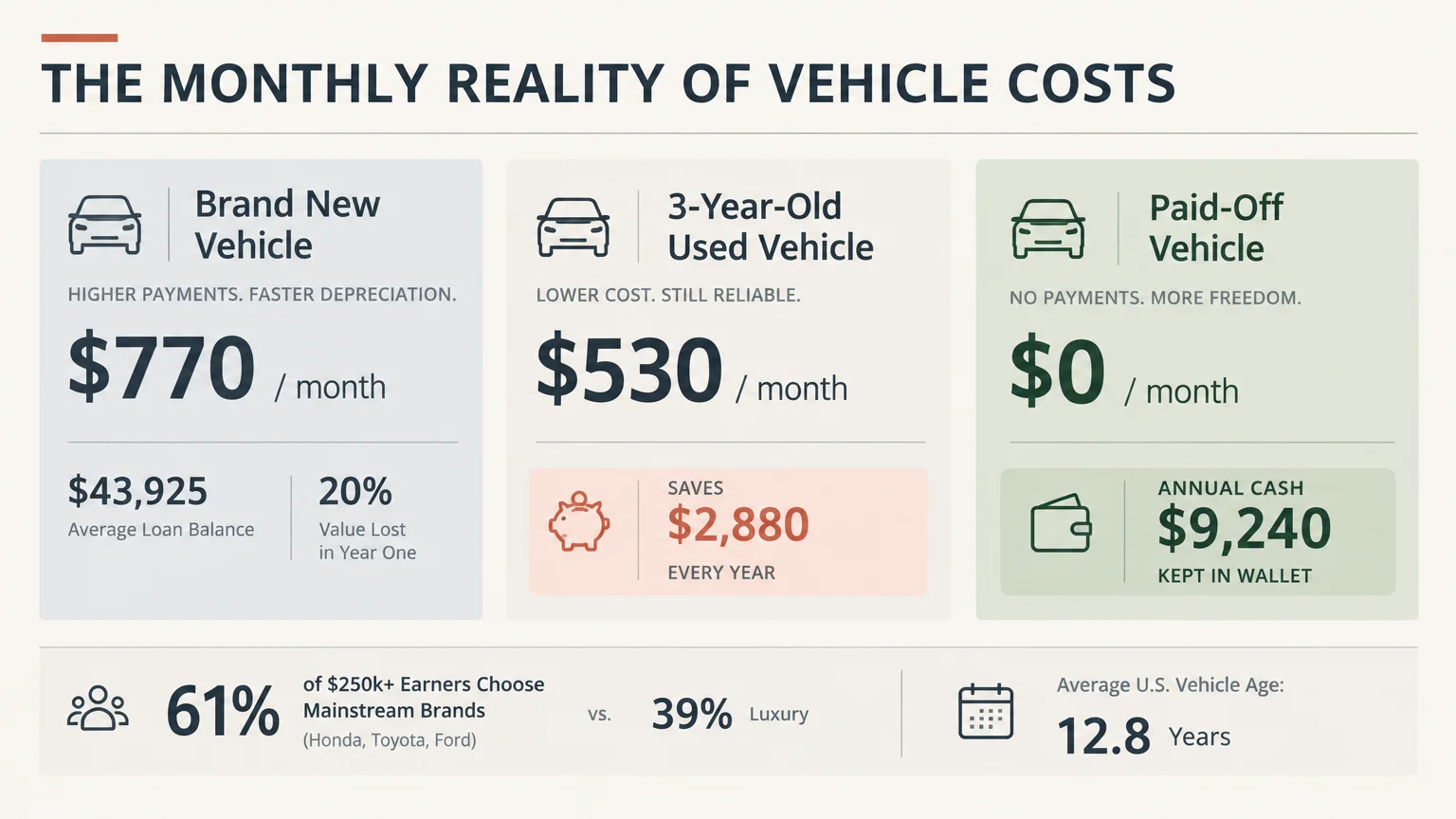
Experian Automotive found that 61% of Americans earning $250,000 or more annually drive mainstream brands like Honda, Toyota, and Ford. Only 39% choose luxury vehicles, and just four of the top ten models driven by those high-earning households carry luxury badges.
That pattern holds true across decades of research on everyday wealth. In The Millionaire Next Door, Thomas Stanley and William Danko reported that only 23.5% of millionaires drive the current year’s model.
Nearly 37% of those millionaires bought their vehicles used, and 25.2% had not purchased a car in four or more years. Adults who grew up financially secure treat a vehicle as transportation, not a rolling billboard for their self-worth.
The Brutal Math Behind New-Car Fever
Buying brand-new cars every few years quietly drains more household cash than almost any other lifestyle habit. Kelley Blue Book and Cox Automotive data show the average new-vehicle transaction price reached $50,562 in September 2026.
Even modest segments now carry eye-watering stickers, with compact cars averaging $27,977, compact SUVs hitting $37,614, and full-size pickups climbing to $67,573. Meanwhile, Kelley Blue Book notes that a new vehicle loses 15% to 20% of its value in its very first year.
CarEdge figures show that depreciation accelerates to 20% to 30% within the first two to three years on the road. You absorb the steepest value drop of the car’s life just to smell fresh carpet.
Monthly payments tell an equally painful story for your everyday budget. Experian’s Q1 2026 auto finance report placed the average new-car loan at $43,925, saddling drivers with an average monthly payment of $770.
How to Copy This Habit Without Driving a Clunker
First, commit to keeping your current car long after the final payment clears. S&P Global Mobility data shows the average age of light vehicles on U.S. roads reached 12.8 years in 2025, proving modern engines easily last well past a decade.
Second, when you genuinely need a replacement, shop for a reliable three-to-five-year-old mainstream model. Kelley Blue Book reported average used-car listing prices topped $26,342 in April 2026, while Edmunds’ Q2 2026 data showed three-year-old used cars averaged $32,461.
Choosing a dependable used vehicle with typical monthly payments around $529 to $532 instead of $770 frees up roughly $240 every month. That single substitution leaves $2,880 in your budget over twelve months—and keeping a paid-off car puts $9,240 a year back into your life.
Use a simple maintenance rule to avoid repair anxiety while driving older cars. Set aside $100 a month in a dedicated car-care envelope for tires, brakes, and fluid changes so a $600 mechanic bill never tempts you into a dealership showroom.
Tip #2: They Treat Restaurant Meals as Rare Events, Not Weeknight Habits
Adults raised in steady households remember how rarely takeout boxes showed up on Tuesday nights. Research from the University of Cambridge, cited by Brigham Young University assistant professor Ashley LeBaron-Black, shows children already form foundational money habits by age seven.
A June 2025 study of 1,117 U.S. adolescents and 1,117 primary caregivers in the Journal of Social and Personal Relationships reinforced that early lesson. Watching parents’ everyday routines—known as parent financial modeling—directly shapes saving habits and money vigilance in adulthood.
When kids watch their parents cook simple meals during the week, restaurant outings feel special rather than mandatory. As adults, those kids carry that same restraint into their own kitchens.
Ramsey Solutions’ National Study of Millionaires, surveying more than 10,000 U.S. millionaires, revealed that 94% live on less than they make. Those respondents also reported spending $200 or less per month at restaurants.
Why Dining Out Quietly Wrecks Your Cash Flow
Compare that $200 monthly ceiling to what the typical household spends today. According to the U.S. Bureau of Labor Statistics (BLS) Consumer Expenditure Survey for 2024, the average U.S. household spends $3,945 a year dining out alongside $6,224 on groceries.
That works out to roughly $329 every single month on restaurant meals, coffees, and takeout orders. Worse, restaurant menu inflation keeps outpacing supermarket prices by a wide margin.
BLS Consumer Price Index and USDA Economic Research Service (ERS) data released in October 2026 showed restaurant prices rose 3.5% year-over-year in September 2026. Grocery prices rose just 1.8% during that same stretch.
Across full-year 2025, restaurant prices climbed 4.1% compared with 2.4% for food bought at home. Every time you tap a delivery app instead of opening your fridge, you pay top dollar for labor and overhead.
USDA ERS data confirms that food away from home now captures 58.9% of total U.S. food spending. Yet 64% of every restaurant dollar pays for wages and benefits, leaving only 5.4 cents for the underlying farm ingredients versus roughly 24 cents per grocery dollar.
Realistic Kitchen Substitutions That Protect Your Social Life
You do not need to eat plain rice and beans to hit a $200 monthly restaurant budget. Start by identifying your behavioral spending triggers—usually exhausted Thursday evenings and rushed weekday mornings.
Stock your freezer with three “emergency” 15-minute meals, such as frozen dumplings, pre-marinated chicken thighs, or pasta with jarred pesto. Knowing dinner takes less time than a delivery driver saves you $45 per skipped takeout order.
Next, protect your social calendar by changing the venue rather than canceling on friends. Host a rotating potluck taco night or board game evening at home instead of splitting $18 cocktails and appetizer tabs at crowded downtown bars.
Trimming your monthly dining spend from $329 down to $180 puts $149 back in your pocket every month. Over one year, that easy kitchen shift adds up to $1,788 in measurable savings without missing a single good conversation.
Tip #3: They Check Secondhand Racks and Coupons Before Paying Retail
Many middle-class shoppers worry that buying secondhand or scanning coupons makes them look broke. Adults who grew up wealthy understand the exact opposite: paying full retail price for depreciating household goods is a sucker’s game.
Ramsey Solutions’ survey of 10,000-plus millionaires found that 93% use coupons all or some of the time. They hunt for discounts automatically because they respect every dollar, regardless of how much sits in their accounts.
That pragmatic mindset has fueled a massive shift in how higher-income households furnish their closets and homes. ThredUp’s 2026 Resale Report, compiled with GlobalData, revealed that 59% of U.S. consumers bought secondhand apparel in 2025.
More importantly, 41% of shoppers now look to secondhand first when seeking value, and 46% browse resale platforms before buying anything new. U.S. secondhand apparel grew 13% in 2025—nearly four times faster than the 3.6% growth of broader retail clothing.
The Quiet Rise of Affluent Resale Shoppers
Resale aisles are no longer limited to bargain basements. Placer.ai data cited alongside ThredUp’s reporting showed the median household income of secondhand shoppers climbed from $74,900 in 2022 to $75,700 in 2025 as thrift shops expanded into affluent neighborhoods.
Even gift-giving traditions are shifting away from glossy retail packaging. ThredUp’s 2026 Holiday Resale Report found that 62% of Americans plan to buy secondhand gifts for the holiday season.
Even better, 55% of respondents said they prefer receiving a one-of-a-kind or vintage secondhand gift in excellent condition over a mass-produced new item. Quality craftsmanship beats a fresh price tag every time.
Your Step-by-Step Resale and Coupon Playbook
Apply a strict “resale-first” rule to furniture, children’s gear, sports equipment, and classic wardrobe staples. Before typing a brand name into a retail storefront, run a five-minute search on local consignment pages or estate sale listings.
Target thrift boutiques located in wealthy zip codes whenever you need blazers, solid-wood dining chairs, or winter coats. Donations in those neighborhoods frequently include lightly worn designer wool and hardwood pieces priced at a fraction of retail.
Pair your resale habit with effortless digital couponing on everyday groceries and household supplies. Download your supermarket’s loyalty app, clip digital store coupons while watching television on Sunday nights, and buy store-brand pantry staples whenever the ingredient list matches.
If your family typically spends $250 a month on clothing, kids’ gear, and home decor, shifting half of those purchases to secondhand cuts your bill to roughly $125 or less. Add $40 a month in grocery app coupons, and you capture $165 in effortless monthly savings—or $1,980 per year.

Tip #4: They Ruthlessly Cut Quiet Subscriptions and Written-Off Fees
Modern companies rarely ask for your money once; they want a permanent pipeline to your checking account. Streaming tiers, cloud storage upgrades, meal kits, and boutique fitness apps all rely on one simple trick: you will forget they exist.
Adults raised in financially secure families show remarkably high “money vigilance”—the term researchers in that June 2025 Journal of Social and Personal Relationships study linked directly to parental modeling. Money vigilance means knowing where every dollar goes before it disappears.
Charles Schwab’s 2024 Modern Wealth Survey highlights how rare deliberate tracking remains across the country. Only 36% of Americans keep a written financial plan, and 43% of those without one assumed they did not have enough money to bother.
Yet the respondents who maintain a written plan consistently report stronger saving habits and greater control over their finances. Meanwhile, Bankrate’s 2026 Annual Emergency Savings Report found 54% of adults say inflation is forcing them to save less.
Stop Paying Rent on Digital Clutter
When everyday prices rise, financially savvy adults refuse to let silent auto-renewals eat their margin. They sit down with last month’s statements and ask a blunt question about every recurring charge: did I use this enough last week to justify buying it again?
Consider how easily subscription creep hides inside an ordinary household budget. A household might pay for four streaming video platforms, an ad-free music tier, a premium news app, and an unused gym membership without blinking.
Each charge feels harmless on its own—just $10 here or $18 there. Combined, however, those forgotten digital rents drain well over $100 every single month for entertainment you barely have time to watch.
The 15-Minute Quarterly Subscription Audit
Schedule a recurring calendar reminder on the first Saturday of every quarter to audit every automatic charge. Print or export your last thirty days of transactions and highlight every recurring bill in bright yellow.
Cancel everything you have not actively used at least four times in the past month. Then apply the “one-in, one-out” rotation strategy to streaming services so you never pay for multiple platforms at once.
Keep one $15 streaming service active for thirty days, finish your favorite shows, cancel it, and switch to a different $15 service the next month. Dropping three overlapping $15 services saves $45 every month—putting $540 a year back into your budget with zero loss of entertainment.
Do the exact same math on fitness and club memberships. Replacing an underused $60 monthly boutique gym with a $15 community recreation pass or brisk neighborhood runs saves $45 a month, pushing your combined subscription savings to $90 monthly—or $1,080 annually.
Finally, write your monthly lifestyle spending limits on a single sheet of paper or simple spreadsheet. Following the lead of that disciplined 36% who keep a written plan turns vague intentions into hard, trackable cash.
Tip #5: They Trade Flashy Upgrades for Cost-Per-Use Quality and Low-Key Fun
Frugal adults from stable backgrounds do not live like monks; they simply refuse to confuse high prices with high quality. They focus intensely on cost-per-use rather than status labels or impulse upgrades.
Ramsey Solutions’ millionaire study illustrates this rejection of empty prestige. Roughly 62% of surveyed millionaires graduated from public state universities, compared with just 8% who attended prestigious private schools.
Even more striking, 79% received zero inheritance, and 80% came from families at or below middle-income levels. They learned early that practical utility outperforms expensive branding in almost every arena of life.
Charles Schwab’s 2025 Modern Wealth Survey reinforces how differently Americans view true comfort today. Survey respondents estimated it takes an average net worth of $839,000 to feel financially comfortable—up from $778,000 in 2024—and $2.3 million to be wealthy.
Only one in five Americans actually feels financially comfortable right now. Tellingly, respondents ranked happiness at 45% right alongside the amount of money they hold at 44% when defining personal wealth.
Using Cost-Per-Use to Avoid Frugal Fatigue
Buying the cheapest version of everything backfires fast and triggers “frugal fatigue”—that exhausted feeling where you eventually snap and overspend. Adults with lifelong money smarts spend deliberately on high-use items while cutting ruthlessly elsewhere.
Run a quick cost-per-use calculation before buying clothing, kitchen gear, or luggage. Divide the item’s sticker price by the realistic number of times you will actually use it over its lifespan.
Suppose you buy a flimsy $50 winter coat that tears after 15 wears; your cost-per-use equals $3.33 per wear. Buying a classic, heavy-duty $150 wool coat that lasts five winters—roughly 150 wears—drops your real cost to $1.00 per wear.
Flip that same math onto impulse purchases like specialty kitchen gadgets or trendy party outfits. A $60 waffle maker used twice costs $30 per breakfast, making it a terrible lifestyle deal compared with a $25 cast-iron skillet used every morning.
Low-Key Entertainment and Budget Travel Hacks
Apply that same value filter to vacations and weekend plans. Instead of booking peak-season flights to tourist traps, travel during shoulder seasons in May or September when hotels slash nightly rates.
Trade expensive weekend amusement parks for free community concerts, state park hikes, and local library perks. Many public library systems offer free museum passes, tool lending libraries, and streaming movie catalogs right on your library card.
When you host friends, lean into low-cost rituals that feel warm rather than cheap. A Sunday afternoon coffee-and-pastry porch hang or a backyard bonfire costs $15 at the grocery store instead of $120 at a trendy brunch spot.
Swapping two $100 weekend outings a month for free library passes, park picnics, and $20 home gatherings saves $160 every month. That equals $1,920 a year in savings while keeping your calendar full of memories.

The Bottom Line: What This Means for Your Wallet
You do not need a wealthy upbringing to adopt the money habits that keep financially secure adults ahead of the game. Every habit on this list relies on everyday consumer choices rather than complicated financial tricks.
Driving paid-off mainstream cars, capping restaurant meals, checking resale racks first, cutting silent subscriptions, and shopping by cost-per-use add up fast. Even adopting just three of these swaps can easily free $400 to $600 every single month.
Best of all, none of these routines require miserable sacrifice or canceling time with the people you love. You simply stop handing your paycheck to marketing hype, convenience markups, and forgotten auto-renewals.
Pick one habit today—whether that means auditing your monthly subscriptions or planning three quick weeknight dinners—and put the savings straight into a goal that actually excites you.
Frequently Asked Questions
Do you have to grow up wealthy to stick with these frugal habits?
Not at all. Ramsey Solutions’ National Study of Millionaires showed that 79% of surveyed millionaires received no inheritance and 80% grew up at or below middle-income levels, proving anyone can learn and practice disciplined consumer habits at any age.
Won’t buying secondhand items or driving an older car hurt my confidence?
Confidence comes from financial breathing room, not monthly car payments or retail price tags. Experian Automotive data shows 61% of households earning $250,000 or more drive mainstream brands like Honda and Toyota, and 59% of U.S. shoppers now buy secondhand apparel.
How can I cut restaurant spending without feeling deprived or losing friends?
Shift the setting instead of skipping social time. Keep a $200 monthly restaurant budget for special occasions, prep three fast weeknight meals at home, and invite friends over for affordable potlucks or game nights instead of splitting overpriced bar tabs.
What is the single fastest habit to copy if my budget feels tight right now?
Run a 15-minute audit of your recurring monthly bills and rotate just one streaming service at a time. Cutting unused memberships and overlapping subscriptions gives you instant monthly cash back without changing your daily meals or commute.
For consumer protection information, visit the Federal Trade Commission (FTC) and the Consumer Financial Protection Bureau (CFPB). For product safety and reviews, consult Consumer Reports.
Disclaimer: This article is for informational purposes only and does not constitute financial advice. The content reflects the author’s opinion and research at the time of writing. Always do your own research before making financial decisions.