Retailers expect U.S. shoppers to spend a record $1.013 trillion across November and December 2026, driven by artificial urgency and flashing countdown timers. You do not have to surrender your wallet to that hype.
Effective holiday savings tips rely on timing every purchase to verified markdown windows, auditing true price histories, and using strict store policy rules to protect your cash.
Apply these ten proven strategies and live holiday deals 2026 to trim your gift expenses while still bringing home durable, high-value items your family will actually use.
Tip #1: Time Every Category to Its Exact Peak Markdown Day
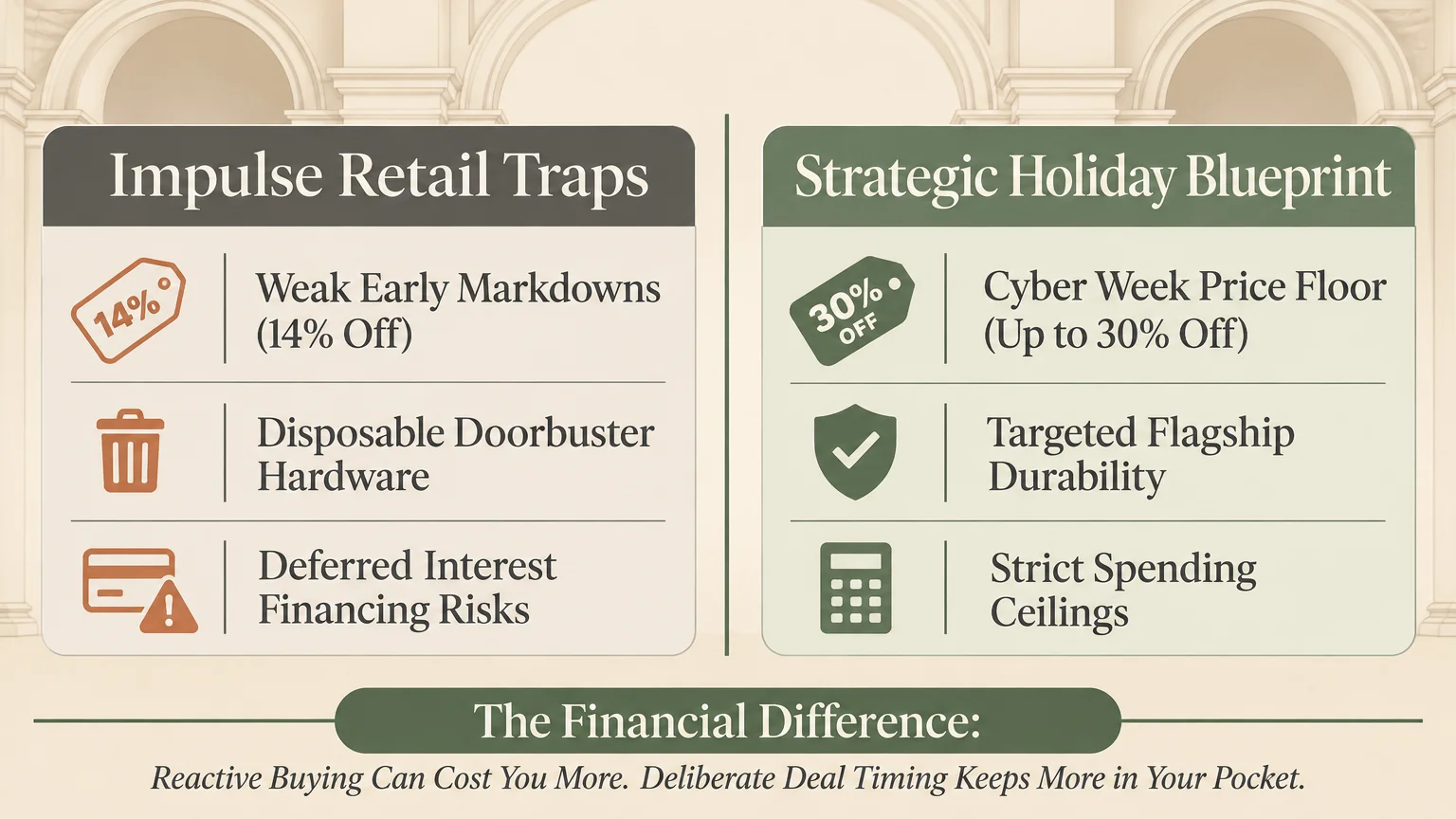
Stores launch holiday promotions earlier every autumn, yet most early bird discounts are weak bait designed to lock in impatient buyers. According to Adobe Analytics, early November markdowns top out around 14% off before climbing to 21% right before Thanksgiving.
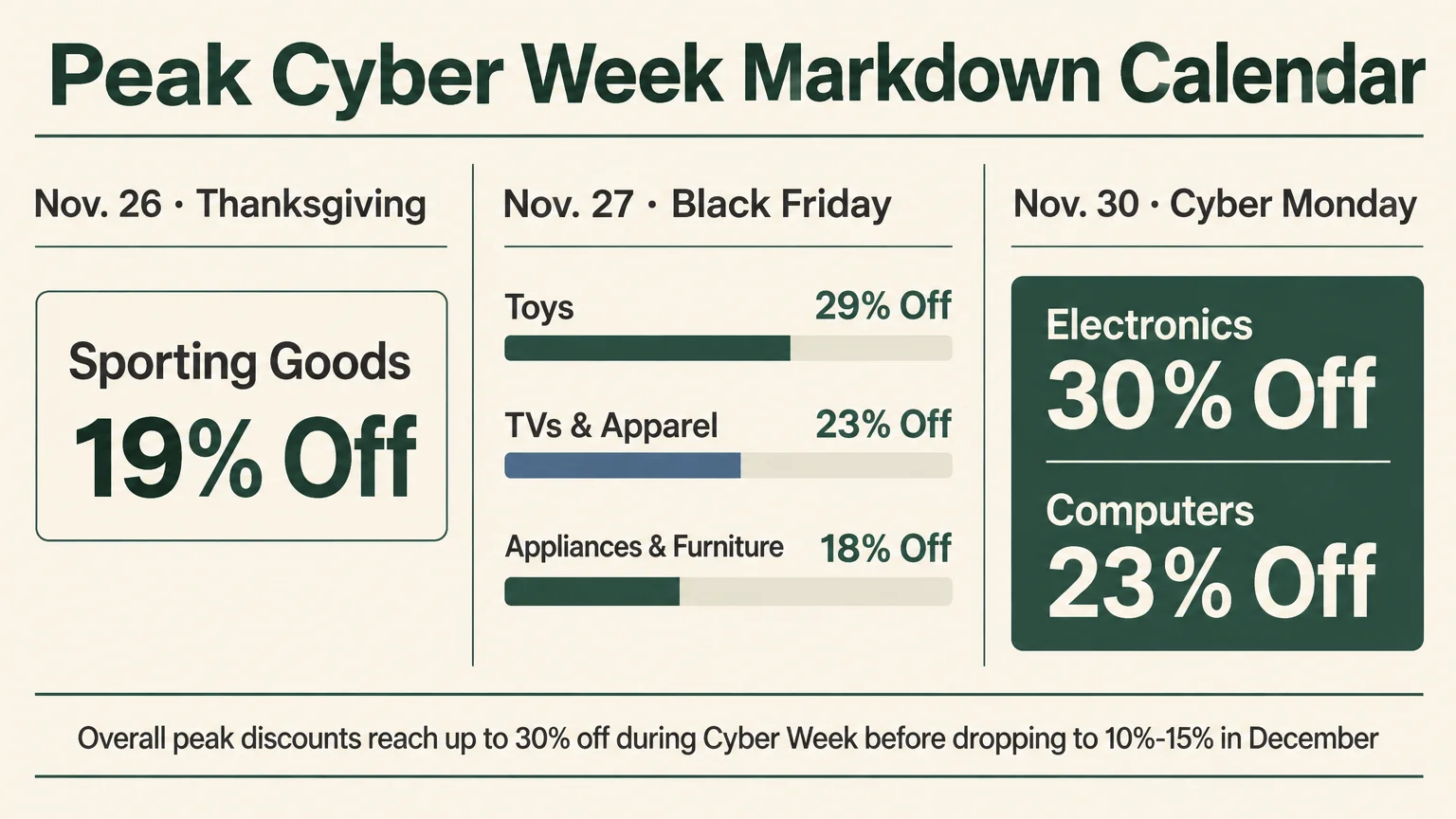
The real price floor arrives during Cyber Week, running from Thanksgiving on Nov. 26 through Cyber Monday on Nov. 30, 2026. Overall discounts peak at up to 30% off during those five days before sliding back to 10% to 15% off in December.
Even within Cyber Week, buying the wrong item on the wrong day costs you serious money. Adobe Analytics data shows each major retail category hits its deepest discount on a specific calendar date.
If sporting goods sit on your list, shop on Thanksgiving Day (Nov. 26), when that category averages 19% off. Wait until Black Friday (Nov. 27) for toys at 29% off, TVs and apparel at 23% off, and appliances or furniture at 18% off.
Hold off until Cyber Monday (Nov. 30) before buying laptops, tablets, and flagship gadgets. Electronics hit their deepest markdown at 30% off on Cyber Monday, while computers drop by an average of 23% off.
This single calendar shift prevents you from overpaying by 10% to 15% on big-ticket items. Match your shopping list to the peak day, and let other shoppers fund the early-November full-price markup.
Tip #2: Target Verified Flagship Markdowns Instead of Doorbuster Bait
Chasing the lowest sticker price on an unfamiliar off-brand TV or bargain-bin mixer is a classic retail trap. Disposable electronics often fail within a year, driving your real cost per use far higher than buying a discounted flagship model.
Instead of settling for stripped-down doorbusters, target verified 2026 black friday deals on proven, durable hardware. Major retailers had substantial discounts live across top-tier electronics and home tools as of Nov. 18–20, 2026.
On Amazon, Tom’s Guide and Mashable report Bose QuietComfort Headphones at $199 (down from $359), the Dyson Supersonic Nural hair dryer at $349.99 (down from $449.99), and the Shark FlexStyle at $199.99 (down from $314). Each of those deals cuts $100 or more off reliable everyday gear.
Big-screen buyers can find similar flagship value at brick-and-mortar giants. Best Buy listed the LG 65-inch B6 4K OLED TV at $599—down sharply from $1,999—alongside the Lenovo Yoga Slim 7x laptop at $649, cut in half from $1,299.
Over at Walmart, shoppers spotted the massive TCL 98-inch 4K QLED TV for $898. You can also grab a combined Walmart+ and Sam’s Club Plus membership bundle for $120 instead of the usual $218.
Console shoppers face a trickier market in 2026 because Sony raised the base PS5 from $549.99 to $649.99 in April and Microsoft bumped the Xbox Series X from $649.99 to $799.99 in August, according to MLQ.ai. That makes the Nintendo Switch 2 plus Mario Kart World bundle at $499.99 (about $50 off from Nov. 22 through Dec. 5) a standout gaming value.
Before you buy any big-ticket doorbuster, divide the sale price by the realistic number of years or uses you expect from the product. Paying slightly more for a tested model almost always beats replacing cheap junk next winter.
Tip #3: Exploit Retailer Sale Windows and Early-Access Schedules
Showing up at a locked store on Thanksgiving or logging on after inventory sells out ruins a solid shopping plan. Every major chain follows a distinct 2026 schedule that rewards shoppers who map out exact opening times and early-access tiers.
Amazon stretches its Black Friday promotion across 12 full days from Nov. 19 through Nov. 30, 2026. Best Buy runs its primary Black Friday event from Nov. 19 to Nov. 28, followed immediately by a two-day Cyber event on Nov. 29 and Nov. 30.
Target schedules its main Black Friday sale from Nov. 22 through Nov. 29, while running a rotating Deal of the Day through Dec. 24. Target Circle 360 members unlock 24-hour early access to select deals starting Nov. 25, giving paid members first crack at limited toy and tech inventory.
Walmart launches its core Black Friday sale from Nov. 23 to Nov. 29, followed by Cyber Monday deals from Nov. 30 through Dec. 2. Paid Walmart+ subscribers get early online access beginning Nov. 23 at 12 a.m. ET—hours before the general public can touch those items.
If you plan to shop in person, skip Thanksgiving Day runs because Best Buy, Target, Walmart, and Sam’s Club remain closed on Nov. 26. All four chains reopen their doors at 6 a.m. local time on Black Friday, Nov. 27.
Early risers hitting department stores should know Kohl’s and JCPenney open even earlier at 5 a.m. local time on Black Friday. Home Depot and Dick’s Sporting Goods open at 6 a.m., while REI keeps its doors shut all day.
Remember that 182.7 million people plan to shop over Thanksgiving weekend, including 126 million on Black Friday and 66.1 million on Cyber Monday, per the National Retail Federation (NRF). Knowing exact launch hours lets you secure top items online without fighting parking lot chaos.

Tip #4: Lock In a Strict Holiday Budget Before Retailers Hook You
Walking into November without a written holiday budget guarantees you will overspend on impulse gifts and flash sales. Retailers engineer every aisle and checkout screen to push your basket past what you planned to spend.
According to Deloitte’s 2026 Holiday Retail Survey, U.S. households plan to spend $1,654 on average—split between $988 for retail goods and $666 for activities and travel. Meanwhile, PwC’s Holiday Outlook 2026 puts average planned gift spending at $708, rising to $875 for parents with children compared to $635 for child-free households.
Those averages hide a sharp split in household wallets. Deloitte notes households earning $200,000 or more plan to spend $3,607 compared to $693 for households under $50,000, while The Conference Board reports lower-income families are actively cutting gift counts and hunting deeper promos.
You do not need to match someone else’s holiday budget to have a great season. PwC found 80% of shoppers plan to use a formal budgeting strategy, and 79% let real deals dictate when they buy.
The NRF also reports 82% of consumers are actively curbing costs this year—25% by buying less expensive gifts, 24% by cutting back in other areas, and 20% by trimming their gift lists. That simple step is one of the fastest ways to save money Christmas shopping.
List every recipient on paper right now, assign a hard dollar cap including sales tax, and tally the grand total before buying a single item. Once a person’s cap is spent, stop browsing for extra stocking stuffers.
Tip #5: Use AI Price Scanners and History Trackers to Spot Fake Markdowns
Stores routinely inflate the crossed-out list price on product pages so a normal 15% discount looks like a massive 45% blowout. Without checking historical pricing, you have no way to tell a genuine holiday steal from a dressed-up average price.
Shoppers are catching on fast to these pricing games by automating their comparison work. According to the NRF, 59% of Thanksgiving weekend shoppers plan to use AI tools—including 25% who track budgets and 25% who scan competing sites for the lowest price.
Adobe Analytics projects AI-referred retail traffic will surge 130% year over year this season. Using automated price alerts and multi-month price charts levels the playing field against dynamic pricing algorithms that shift numbers multiple times a day.
Before checking out on any deal, run a quick three-step audit on your screen. First, inspect at least 90 days of price history to verify whether the current price actually beats recent autumn lows.
Second, compare the total landed cost—item price plus shipping and handling—across at least three competing retailers. Third, check unit prices on multipacks, gift baskets, and boxed sets rather than trusting bundle banners that claim instant savings.
Take extra care if you shop on a smartphone, where tiny screens hide fine print and encourage one-tap impulse buys. Mobile devices will drive 57.4% of full-season online spend and 63% of Thanksgiving Day online spend, per Adobe Analytics, so slow down before confirming mobile checkouts.

Tip #6: Stock Up on Everyday Household Essentials During Cyber Week
Most people treat Cyber Week strictly as a gift-buying sprint and miss one of the easiest ways to slash monthly grocery and household bills. Retailers discount everyday consumables heavily in late November to boost order volume and clear warehouse space.
Adobe Analytics forecasts massive Cyber Week order surges compared to September baselines across non-gift staples. Online orders are projected to jump 210% for clothing basics, 150% for personal hygiene items, 113% for baby products, 93% for pet goods, and 49% for cleaning supplies.
Buying detergent, diapers, socks, toothpaste, and pet food during those deep Cyber Week promos stretches your winter cash flow well into spring. Look for stackable multi-buy promos, store brand discounts, and subscription-style coupon drops you can cancel right after delivery.
Always verify the real unit price—cost per ounce, per sheet, or per count—using your phone calculator before tossing bulk boxes into your cart. Holiday-themed packaging often shrinks the net weight inside the box while keeping the outer carton looking big.
If a Cyber Week bundle lowers your cost per unit by 20% to 30% on items you burn through every month, stock up within your storage limits. Every dollar saved on paper towels and pet kibble frees up real cash without touching your gift quality.
Tip #7: Navigate the New 2026 Price-Match Loopholes and Limitations
Many shoppers still assume they can buy a gift early at any big-box chain and demand a refund later if a rival drops the price. That assumption no longer holds water in 2026 because major retailers quietly gutted their price-matching rules.
Amazon does not price match at all, and Walmart also refuses to match competitor or post-purchase prices. Once you buy from either retailer, your only recourse on a steeper price drop is returning the unopened item and reordering it.
Target permanently ended competitor price matching on July 28, 2025, fundamentally changing how savvy shoppers use the store. For the 2026 season, Target only matches its own lower prices—across physical stores, Target.com, and Target Circle—for purchases made between Nov. 1 and Dec. 24, 2026.
Best Buy maintains the widest adjustment window, allowing you to match Best Buy’s own lower prices through Jan. 15, 2027, on items bought between Oct. 30 and Dec. 31, 2026. However, Best Buy’s competitor price matching excludes third-party marketplace sellers, Prime-exclusive offers, and Thanksgiving-through-Cyber-Monday blackout dates.
Put these exact rules to work by organizing every digital receipt from Target and Best Buy in one dedicated email folder. Set a quick calendar reminder for mid-December and early January to rescan those exact product pages for lower store prices.
When a price dips inside the allowed window, contact customer support via chat with your order number ready to claim the difference back. That five-minute habit recovers real cash without repacking a single box.
Tip #8: Master Extended Holiday Return Windows and Spot Hidden Exclusions
Buying gifts early only protects your wallet if you can cleanly return duds, wrong sizes, or duplicate presents after December 25. Retailers extend return windows for the holidays, yet sneaky category cutoffs and third-party seller traps catch careless shoppers off guard.
At Amazon, most purchases made from Nov. 1 through Dec. 31, 2026, remain returnable through Jan. 31, 2027. Watch out for one major exception: Apple-branded products carry a tighter cutoff and must go back by Jan. 15, 2027.
Walmart accepts returns through Jan. 31, 2027, on most eligible items bought between Oct. 1 and Dec. 31, 2026. However, Walmart excludes wireless phones (14-day limit), major appliances, protection plans, Dyson products, select seasonal or luxury goods, and third-party Marketplace items that usually keep a 30-day window.
Target starts its extended return clock on Dec. 26 for items bought Nov. 1 through Dec. 24, 2026. Electronics and entertainment items can go back through Jan. 24, 2027, while Apple devices, Beats gear, and mobile phones face a tight Jan. 8, 2027 deadline.
Best Buy allows returns through Jan. 15, 2027, on most gifts bought Oct. 30 through Dec. 31, 2026. Paid My Best Buy Plus and Total members receive an extra cushion until Jan. 31, 2027.
Notice the common traps across every store: third-party marketplace listings and Apple or mobile gear rarely follow the generous late-January calendar. Always verify who actually ships and sells the item on the product page, and circle early-January electronics deadlines on your calendar.
Tip #9: Dodge High-Interest Store Financing and the BNPL Trap
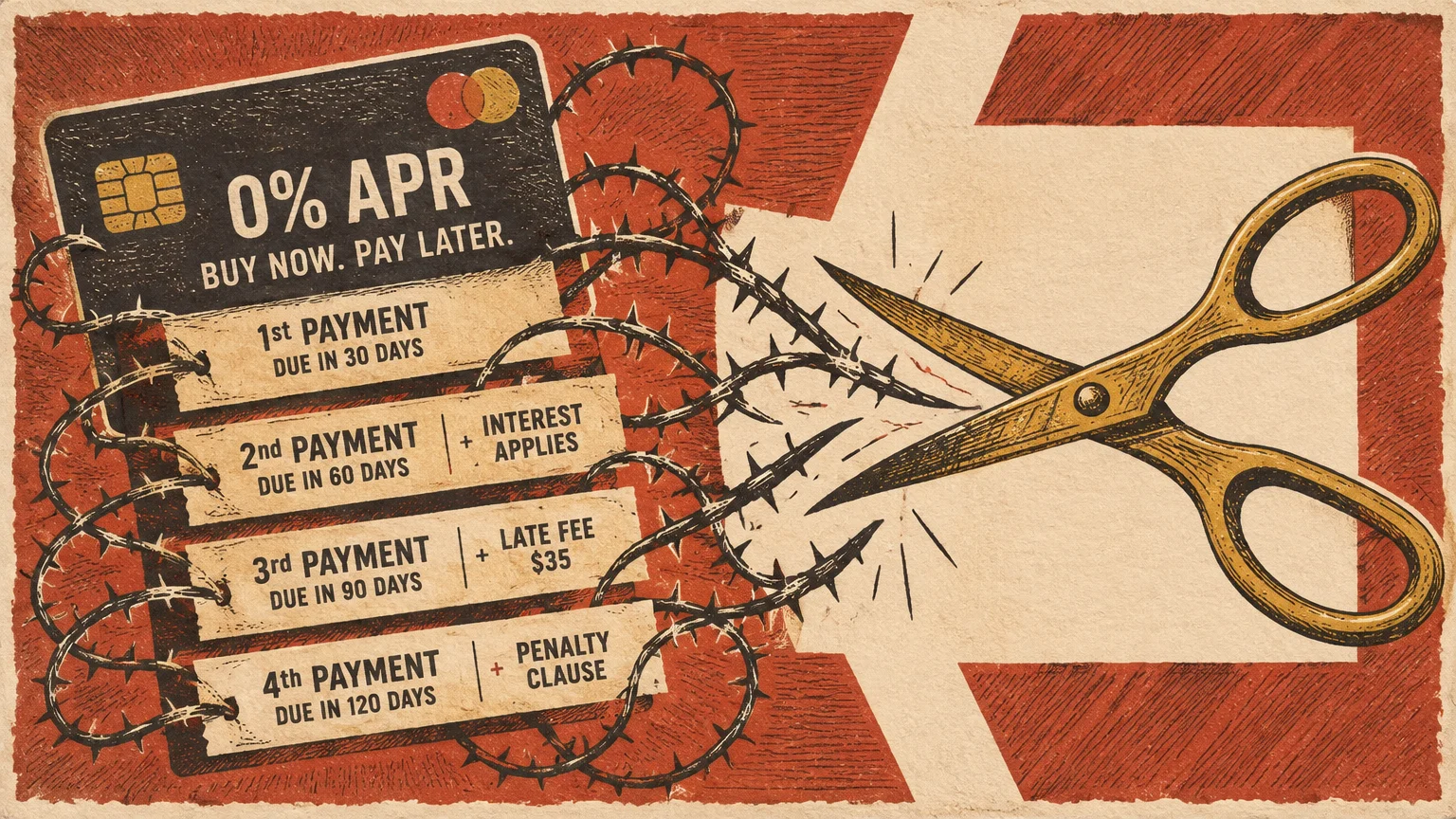
Scoring 25% off a Black Friday deal means nothing if financing charges wipe out those savings by February. Retailers push checkout financing harder than ever because interest payments turn modest gifts into expensive multi-month anchors.
According to LendingTree, 37% of Americans took on holiday debt last season, averaging $1,223 overall and $1,324 for parents of children under 18. Nearly two-thirds expected to spend three months or longer paying it down, and 41% were still paying off prior-year holiday balances when the new season began.
Store-branded financing carries brutal rates that crush household budgets. The CFPB reports private-label retail store cards average 31.3% APR compared to 25.2% on general-purpose cards, while Bankrate places store card rates around 30% APR and Federal Reserve data cited by Debt.com puts the average assessed credit card rate at 22.36% as of August 2026.
If a store cashier offers an instant 15% discount for opening a store card at the register, do the math first. Carrying a balance on that 30% APR card quickly erases the small upfront discount.
Buy Now, Pay Later (BNPL) installment buttons pose an equally sneaky threat during checkout. Adobe Analytics projects BNPL will drive $21.3 billion in U.S. online spending across November and December 2026—including $1.09 billion on Cyber Monday and $807 million on Black Friday—with 82% of those orders placed on mobile phones.
Splitting four or five separate gifts into four-part installment plans makes your cart feel lighter on Black Friday, yet those stacked automatic drafts collide in December and January. Stick to cash or balances you can clear immediately, and walk away from any deal that requires installment financing.
Tip #10: Hit 2026 Shipping Deadlines and Shield Yourself from Holiday Scams
Procrastinating past standard shipping cutoffs forces you to pay for costly rush overnight delivery, instantly wrecking your holiday savings. Lock in the official 2026 domestic carrier deadlines now so your gifts arrive on time at ground rates.
For U.S. Postal Service delivery before Dec. 25, ship by Dec. 17 for Ground Advantage and First-Class Mail, Dec. 18 for Priority Mail, and Dec. 19 for Priority Mail Express. At UPS, delivery by Dec. 24 requires shipping by Dec. 21 for 3 Day Select, Dec. 22 for 2nd Day Air, and Dec. 23 for Next Day Air.
FedEx delivery by Dec. 24 sets cutoffs at Dec. 15 for Ground Economy, Dec. 17–23 for FedEx Ground and Home Delivery (depending on your transit lane), Dec. 21 for Express Saver, Dec. 22 for 2Day and 2Day AM, Dec. 23 for Overnight services, and Dec. 24 for SameDay.
While racing those deadlines, stay alert for holiday fraudsters targeting hurried buyers. Consumers reported over $12.5 billion in fraud losses in 2024, with gift card scams representing roughly 25% of all reports, according to the FTC.
The Identity Theft Resource Center warns that nearly 40% of holiday shoppers hunt for bargains on unfamiliar websites, and about 1 in 3 people have given or received a tampered, drained gift card pulled straight from a retail rack. Meanwhile, AARP and Quartz report 39% of adults who bought through an online ad experienced fraud, and 47% say they are likely to use peer-to-peer payment apps like Cash App, Venmo, or Zelle—which strip away dispute protections.
Follow the FTC’s Nov. 19, 2026 guidance every time you shop online or in stores. Scroll past paid top search ads to reach real organic merchant links, never pay any business or agency with a gift card, and keep gift card receipts and ID numbers for fraud claims.
Paying with a standard payment method that preserves formal dispute rights—rather than peer-to-peer transfers—protects you if a merchant vanishes or ships damaged goods. Always vet unknown storefronts before typing in your address.
For consumer protection information, visit the Federal Trade Commission (FTC) and the Consumer Financial Protection Bureau (CFPB). For product safety and reviews, consult Consumer Reports.
The Bottom Line: What This Means for Your Wallet
Beating retail markups in 2026 comes down to disciplined timing and strict resistance against manufactured urgency. Retailers spend billions perfecting countdown clocks, early-November hype, and installment buttons to make you spend past your limit.
You keep the upper hand by anchoring your list to verified peak discount days—Thanksgiving for sporting goods, Black Friday for toys and TVs, and Cyber Monday for electronics and computers. Pair those dates with multi-month price-history audits, real unit-price math on Cyber Week household staples, and strict cost-per-use evaluation on major electronics.
Keep every digital receipt from Target and Best Buy to claim post-purchase price adjustments before windows shut, and watch those early January return cutoffs on Apple devices and third-party marketplace orders. Finish your shipping before mid-December carrier deadlines hit, protect your money from payment-app and gift-card traps, and enter January debt-free with your savings intact.
Frequently Asked Questions
When do holiday deals 2026 actually hit their lowest prices?
According to Adobe Analytics, overall online discounts peak at up to 30% off during Cyber Week (Nov. 26–30, 2026). Early November caps around 14% off, and December discounts typically drop back down to 10% to 15% off.
Which major retailers still match competitor prices during the 2026 holidays?
Amazon and Walmart do not price match at all, and Target ended competitor price matching in July 2025—matching only its own lower prices from Nov. 1 through Dec. 24, 2026. Best Buy matches its own lower prices through Jan. 15, 2027, while blocking competitor matches on marketplace sellers, Prime exclusives, and Thanksgiving-through-Cyber-Monday blackout days.
Are physical gift cards on store racks safe to buy this holiday season?
Store-rack gift cards carry real tampering risk; about 1 in 3 people have given or received a compromised, drained card, per the Identity Theft Resource Center. Always check for peeled stickers or scratched PIN strips, ask for cards kept behind the register, and hand the recipient the original activation receipt.
What are the final 2026 shipping dates to avoid pricey overnight rush fees?
To get packages delivered before Dec. 25 without express surcharges, use USPS Ground Advantage or First-Class Mail by Dec. 17, or UPS 3 Day Select by Dec. 21. FedEx Ground Economy closes earliest on Dec. 15, while standard FedEx Ground lanes close between Dec. 17 and Dec. 23 depending on distance.
Disclaimer: This article is for informational purposes only and does not constitute financial advice. The content reflects the author’s opinion and research at the time of writing. Always do your own research before making financial decisions.