Timing your tech purchases around predictable retail cycles can easily slash hundreds of dollars from your household budget without forcing you to settle for inferior hardware. Modern consumer electronics follow rigid manufacturing and promotional calendars, meaning full retail prices are essentially an impatience tax on buyers who cannot wait for the next markdown. When you map your device upgrades to the nine annual discount windows outlined below, you reclaim control over your cash flow while securing top-tier laptops, televisions, and smart home gear. Rather than reacting to unexpected device breakdowns with high-interest credit cards, you can anticipate every major purchase strategically.

The Financial Reality of Household Tech Upgrades
Consumer technology is no longer a luxury category; it is essential infrastructure for work, education, and daily communication. When a family computer fails or a television burns out, the pressure to replace it immediately often leads to rushed buying decisions at peak retail prices. According to consumer credit data tracked by the Federal Reserve, revolving credit balances continue to strain family finances, making unplanned four-figure tech expenses a frequent catalyst for high-interest debt. If you carry an unexpected computer purchase on a standard credit card, accumulated interest can quickly wipe out any minor promotional discount you found at the register.
Retailers understand consumer urgency and structure their pricing algorithms accordingly. Electronics prices fluctuate dynamically throughout the year based on supply chain arrivals, manufacturer quotas, trade shows, and annual holiday sales events. When you step off the manufacturer upgrade treadmill and align your shopping with standard clearance schedules, you shift the psychological advantage in your favor. You stop paying for marketing hype and start paying for raw utility at wholesale-adjacent prices.
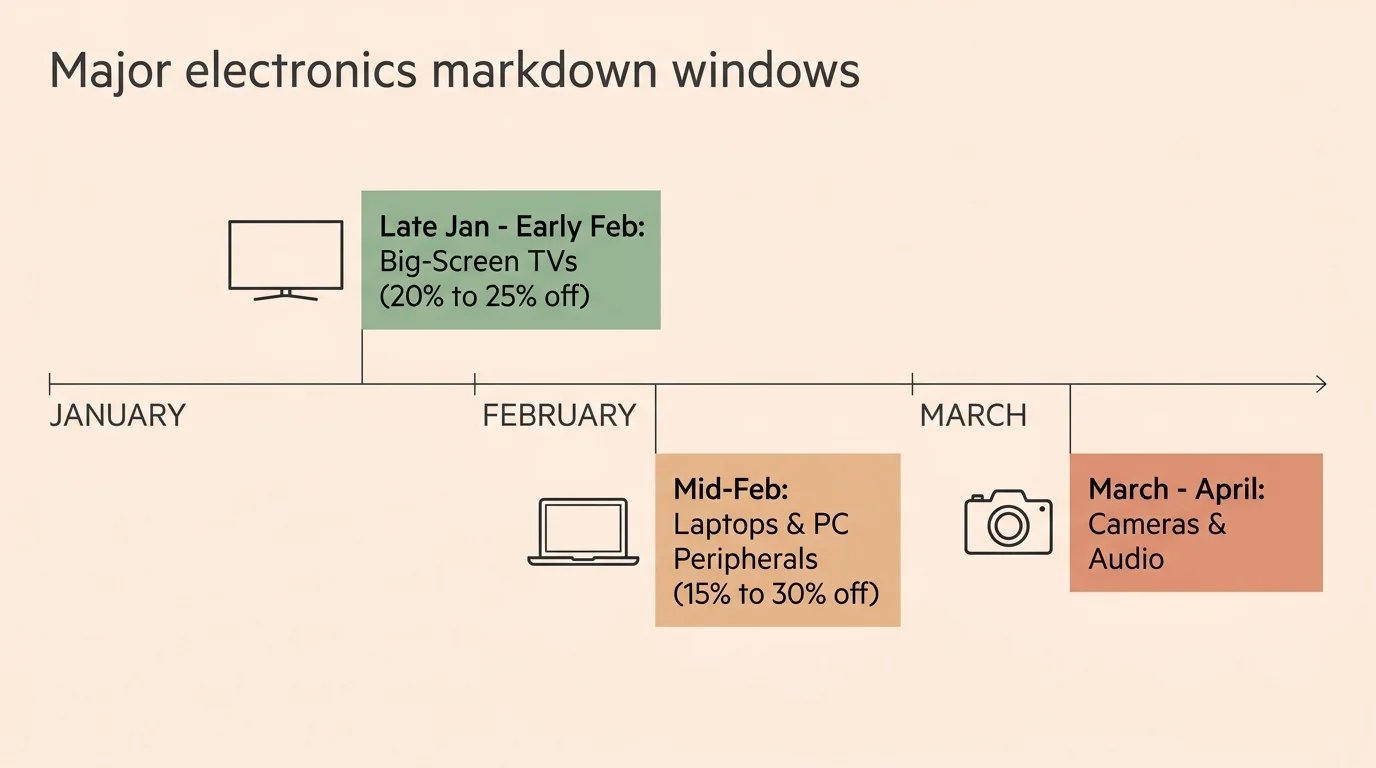
The Master Electronics Sale Calendar: 9 Windows for Deepest Discounts
Every major tech category undergoes a predictable markdown cycle governed by international manufacturing timelines and dealer incentives. Understanding these distinct windows allows you to pinpoint the cheapest time to buy electronics without guessing.
1. Super Bowl Season (Late January to Early February): Big-Screen TVs
The two weeks leading up to the Super Bowl represent the second-best television-buying window of the entire calendar year. Retailers capitalize on intense sports viewership demand by slashing prices on 55-inch and larger sets to capture shoppers looking to upgrade before game day. Pricing data from Consumer Reports indicates that average markdowns reach 20% to 25% off previous-year flagship models during this promotional stretch. Retailers use this window aggressively because new television models debuted at the January Consumer Electronics Show arrive in warehouses by April, forcing managers to purge older stock immediately.
2. Presidents Day Weekend (Mid-February): Laptops and PC Peripherals
Presidents Day weekend serves as a critical mid-winter clearance event for personal computers, external monitors, and office peripherals. As computer manufacturers prepare to ship new laptop models powered by next-generation processors announced earlier in the winter, major retail outlets offer 15% to 30% discounts on existing inventory. You will find especially lucrative price cuts on mid-tier business laptops and versatile two-in-one productivity devices. This weekend provides an ideal opportunity for households needing reliable work-from-home machines without paying current-generation premiums.
3. Japanese Fiscal Year-End (March to April): Cameras and Audio Equipment
A lesser-known industry secret centers on the corporate calendar of major Japanese electronics conglomerates, including Sony, Canon, and Nikon. Because their fiscal year closes on March 31, these manufacturers push aggressive dealer incentives, instant manufacturer rebates, and bundled lens promotions during March and April to hit annual balance-sheet targets. This seasonal window delivers substantial savings on mirrorless cameras, premium lenses, high-fidelity soundbars, and noise-canceling headphones as stores clear shelves ahead of late-spring hardware shipments.
4. Memorial Day Weekend (Late May): Smart Home and Home Entertainment
Memorial Day weekend officially kicks off the summer shopping season with extensive price cuts focused on smart home ecosystems and outdoor entertainment. Retailers drop prices by 15% to 35% on smart thermostats, video doorbells, mesh Wi-Fi networks, soundbars, and weather-resistant outdoor audio systems. If you plan to automate your home or upgrade your living room sound profile before hosting summer gatherings, this late-spring sale window provides high-value markdowns from leading connected-device brands.
5. Mid-Summer Mega Sales (Mid-July): Smart Hardware, Tablets, and E-Readers
Amazon Prime Day and competing counter-events—such as Best Buy’s Black Friday in July—have permanently reshaped the mid-year retail landscape. Comprehensive e-commerce tracking from Adobe Analytics reveals that electronics discounts average 20% to 24% during this multi-day window. First-party smart devices, including smart speakers, video streaming sticks, and digital tablets, regularly hit steep price cuts of 40% to 50% or more. Rival retailers aggressively match these prices on high-end noise-canceling headphones, smartwatches, and premium tablets to keep consumer dollars from migrating to single-platform ecosystems.
6. Back-to-School Season (Late July to Labor Day): Student Laptops and Tablets
The late-summer back-to-school corridor creates intense competition among computer manufacturers fighting for student and parental dollars. Retailers routinely discount laptops, graphic tablets, and cloud-storage hardware by 15% to 25%. Premium manufacturers like Apple participate through annual education promotions that bundle $100 to $150 gift cards with hardware purchases. Savvy shoppers can compound these retailer markdowns by timing their purchases during state sales-tax holidays, generating immediate baseline savings before factoring in merchant discounts.
7. Post-Keynote Autumn Release Cycle (September to October): Previous-Gen Phones
September and October bring the annual onslaught of flagship smartphone announcements from major manufacturers. The moment a tech giant reveals a new flagship device, previous-generation models instantly receive retail price cuts of $100 or more across carrier stores and authorized merchants. Mobile carriers also roll out lucrative trade-in credits to prevent churn during this upgrade cycle. If you avoid the psychological trap of needing the absolute newest camera sensor, buying the prior year’s flagship during this window secures premium build quality and years of software support at a fraction of the cost.
8. Black Friday and Cyber Week (Late November to Early December): Annual Peak Clearance
Cyber Week remains the absolute deepest broad-scale discount window across almost every consumer electronics category. Multi-year digital economy reports show online consumer electronics discounts peaking between 30% and 31% off list prices, while computer systems discount at an average peak of 20% to 23%. This holiday corridor is the premier time to purchase home theater receivers, gaming consoles, 4K OLED screens, and premium wearable tech. The volume of simultaneous sales makes it effortless to leverage retailer price matching and promotional gift card offers.
9. Post-Holiday Clearance (Late December to Mid-January): Open-Box and Refurbished Gear
The post-holiday window from December 26 through mid-January produces an unprecedented surge in returned electronics and excess seasonal inventory. Retailers are flooded with open-box merchandise—items returned simply because of duplicate gifting or buyer remorse rather than hardware defects. Major electronics chains and warehouse clubs routinely discount open-box and manufacturer-certified refurbished laptops, monitors, and televisions by 15% to 40% off original retail. These items typically retain full manufacturer warranties and pristine physical conditions, making post-holiday clearance the ultimate bargain hunter’s secret.

Strategic Pillars: How to Fund Upgrades Without Debt
Knowing when electronics go on sale solves only half the financial equation; you must also establish a sustainable cash-flow strategy to fund those upgrades. Relying on emergency savings or credit limits turns even deeply discounted gadgets into long-term financial liabilities.
The first pillar requires establishing an automated tech sinking fund. Instead of waiting for a family device to break and scrambling for cash, calculate your household hardware replacement costs over a four-year horizon and divide that number by 48 months. Diverting $35 to $50 each month into a dedicated high-yield savings account ensures you hold liquid funds the moment an optimal sale window opens. This simple automation eliminates the psychological panic that drives impulsive, full-price buying.
The second pillar involves adopting a strict two-year hardware lag. Tech marketing teams convince consumers that annual iteration equals revolutionary progress, yet year-over-year performance gains for everyday tasks have slowed dramatically. Buying hardware that is twelve to eighteen months old provides 90% of the newest model’s utility for roughly 60% of the cost. This disciplined lag allows you to bypass the steep initial depreciation curve that early adopters absorb.
The third pillar centers on stacking savings mechanisms. Never accept a single promotional discount as the final price. Combine seasonal sale pricing with cash-back shopping portals, authorized manufacturer trade-in programs, and credit card reward points redeemed for cash equivalents. Layering these tools frequently extracts an additional 8% to 15% in total savings from a purchase that was already marked down by the merchant.
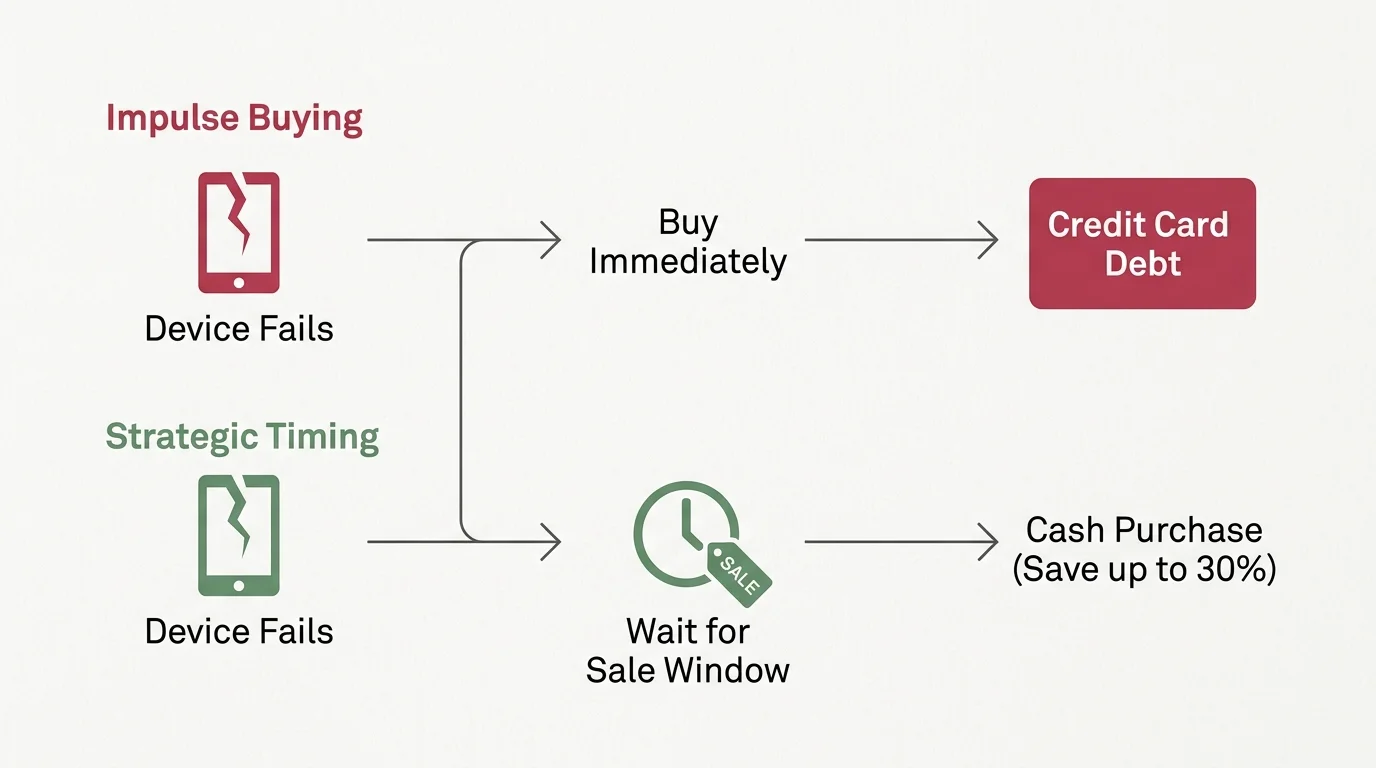
Action Lab: Strategic Timing vs. Impulse Purchasing
To see the financial impact of seasonal planning, consider a realistic household scenario involving two standard hardware needs: a 65-inch 4K living room television and a dependable mid-tier laptop for remote work and budgeting. Many families purchase these items reactively, buying at random intervals during the year when older items slow down.
In an impulse-buying scenario, you might buy a current-model 65-inch television in October for its standard MSRP of $1,200, followed by a mid-tier laptop in April for $950, totaling $2,150. If you fund this combined $2,150 purchase across two credit card cycles at an average 21.5% interest rate and take twelve months to pay it off, finance charges add roughly $260, bringing your true out-of-pocket expenditure to $2,410.
In a strategic seasonal scenario, you purchase the television in late January during Super Bowl clearance for $900 (a 25% markdown on a proven previous-year model) and buy the laptop during late-summer Back-to-School promotions for $760 (a 20% discount). Furthermore, the back-to-school promotion includes a $100 student retailer gift card that offsets upcoming home office supplies. You pay for both purchases from your automated sinking fund, incurring zero interest charges. Your total cost for the exact same functional utility is $1,560 net—a decisive cash savings of $850 that remains in your family emergency fund.

Guardrails and Pitfalls to Avoid During Major Sales
Deep retail discounts often conceal deliberate merchandising traps designed to capture unsuspecting shoppers. Awareness of these traps protects both your wallet and your hardware performance expectations.
Beware of derivative doorbuster models, particularly during Black Friday and mid-summer retail events. Major manufacturers produce special holiday-specific SKUs that look identical to flagship product lines from the outside but feature stripped-down components internally. These derivative models frequently cut costs by using cheaper display panels, fewer HDMI ports, lower-quality audio speakers, and slower internal processing chips. Always cross-reference the exact alphanumeric model number with independent reviews before heading to the checkout register.
Reject overpriced point-of-sale extended warranties and retailer insurance packages. Guidance from consumer protection organizations like the Consumer Financial Protection Bureau underscores how expensive add-on financial products drain household budgets while providing overlapping protection. Many standard credit cards automatically extend manufacturer warranties by an additional twelve months at no extra charge when you pay with that card, rendering store-bought warranties an unnecessary and expensive redundancy.
Exercise strict caution with Buy Now, Pay Later (BNPL) micro-installment services embedded into online checkouts. These point-of-sale financing tools make a $900 purchase feel like a manageable $225 expense, encouraging consumers to buy higher-tier models than their budget supports. Financial advisories published by the Federal Trade Commission highlight that split-payment loans can easily lead to missed-payment fees, overdraft charges, and phantom debt accumulation across multiple simultaneous platforms.
Frequently Asked Questions About Electronics Discounts
Are open-box electronics safe to buy?
Yes, open-box electronics are among the most cost-effective purchases you can make, provided you buy from authorized retailers. Most open-box items are customer returns triggered by wrong size selections or duplicate gifts rather than technical defects. Reputable retailers thoroughly inspect, test, and recertify these devices, often including the complete original manufacturer warranty and standard return privileges. Always verify the cosmetic condition grade and inspect all essential accessories before completing the purchase.
Is Black Friday always cheaper than Prime Day for electronics?
Black Friday offers broader category-wide discounts, particularly for premium home theater equipment, desktop computers, and gaming hardware. Mid-summer sales like Prime Day excel primarily in smart home ecosystems, voice-assistant devices, e-readers, and mid-range mobile accessories. If you need a comprehensive home entertainment overhaul, November is generally superior; if you want to expand your smart home ecosystem or replace wireless earbuds, mid-summer provides equivalent or deeper price cuts.
How can you verify whether a sale price is genuinely a good deal?
Retailers occasionally inflate base reference prices immediately before major holidays to make standard markdowns appear artificially generous. To verify true value, utilize automated price-tracking browser extensions and historical price databases. These tools display a product’s price history over twelve months, letting you instantly confirm whether a promotional tag represents an authentic annual low or simply routine retail pricing disguised as a holiday doorbuster.
When do video game consoles see their biggest price cuts?
Dedicated video game consoles rarely receive direct, standalone price cuts from manufacturers outside of hardware generation transitions. Instead, the deepest value windows occur during Black Friday and Cyber Week through promotional hardware bundles. During this period, manufacturers package consoles with popular games, extra wireless controllers, and subscription access at standard retail pricing, delivering $60 to $120 in effective promotional value.
Build Your Household Electronics Calendar Today
Smart money management is not about depriving your household of modern technology; it is about refusing to pay an arbitrary premium due to poor timing. Take twenty minutes tonight to perform a complete inventory of your home’s electronic devices. Note the age of your primary work laptop, family televisions, tablets, and phones, and estimate which items will likely require replacement over the next twelve to eighteen months.
Align those replacement milestones directly with the promotional windows on this seasonal calendar, and set up an automatic monthly transfer into your tech sinking fund. When you replace impulse shopping with disciplined seasonal execution, you stretch every paycheck further while enjoying premium technology throughout your home.