You can instantly protect your hard-earned paycheck from deceptive retail markups by learning how stores manipulate reference pricing before major sales events. Spotting an inflated original price ensures that you only spend money on genuine bargains rather than fabricated discounts designed to trigger impulse buying. Retailers frequently exploit our natural desire for savings by hiking list prices days before a promotion, only to slash them back down to standard retail levels. By developing a sharp eye for historical pricing patterns, model variations, and regulatory compliance standards, you transform from a passive consumer into an empowered shopper who dictates the real value of every purchase.
The Mechanics of Reference Price Inflation: Why Fake Sales Dominate Retail
Walk into almost any department store or browse an ecommerce storefront, and bright red discount badges immediately promise dramatic markdowns of 40%, 50%, or even 70% off. However, behavioral researchers have long demonstrated that these steep discounts rarely reflect genuine price cuts. Instead, retailers rely heavily on a cognitive bias known as anchoring; by establishing an artificially high original reference price, merchants trick your brain into viewing the regular selling price as an irresistible bargain.
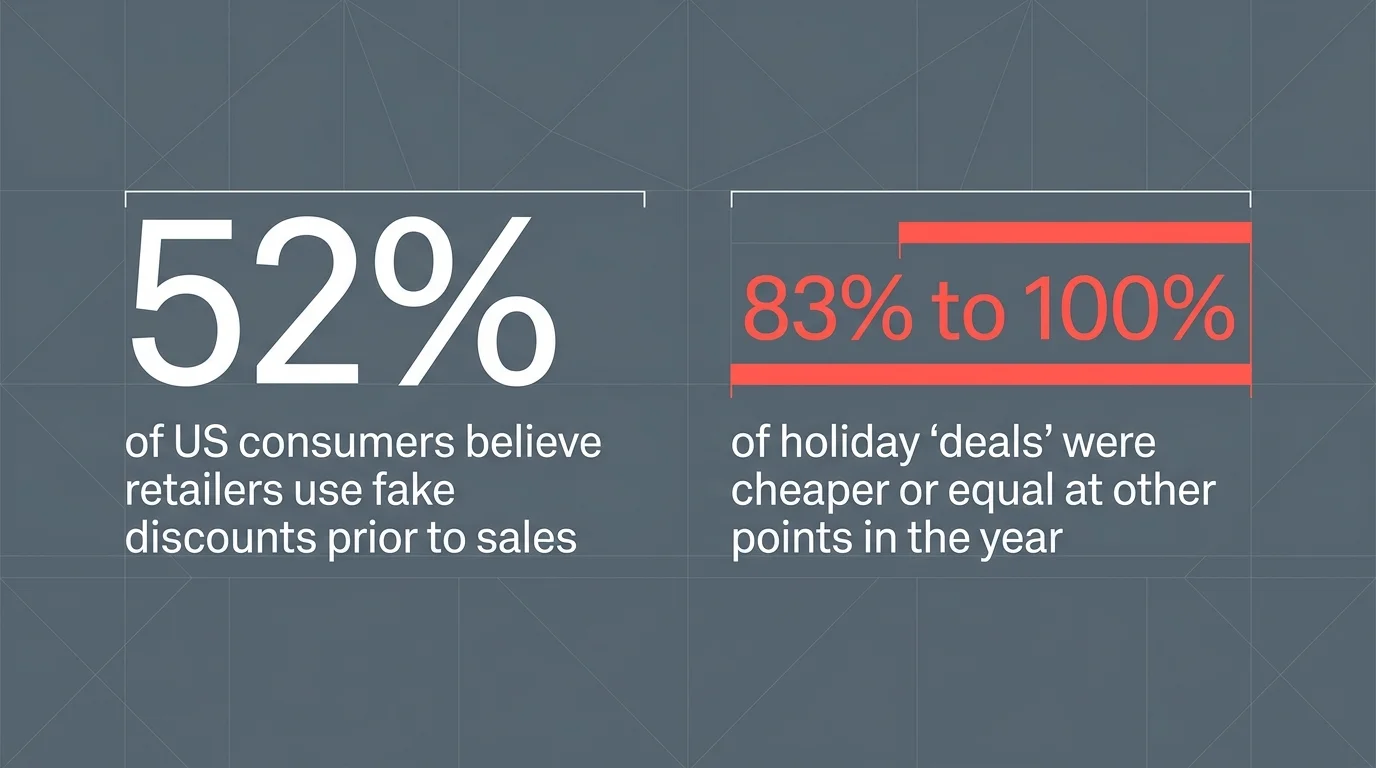
Shoppers increasingly recognize these manipulative tactics across the retail landscape. A seventeen-market global survey conducted by YouGov revealed that 52% of U.S. consumers believe retailers regularly use fake discounts by inflating prices immediately prior to sales. Independent consumer watchdogs confirm that this widespread skepticism is entirely justified. A multi-month investigation by Consumers’ Checkbook tracked thousands of items across twenty-five major retail chains and discovered that twenty-one of those companies kept products marked as on sale more than half the time, effectively turning the promotional rate into the everyday baseline price.
Further research underscores how widespread this practice has become across major promotional holidays. A comprehensive historical price study by consumer group Which? analyzed major appliance and consumer tech deals across a twelve-month span, finding that between 83% and 100% of advertised promotional items were available for the exact same price or cheaper at other points during the year. When merchants artificially inflate strikethrough numbers, they distort your perception of value and tempt you to sacrifice your household savings on phantom discounts.
7 Strategic Ways to Spot Inflated Original Prices and Fake Discounts
1. Analyze Historical Price Graphs Across Multi-Month Windows
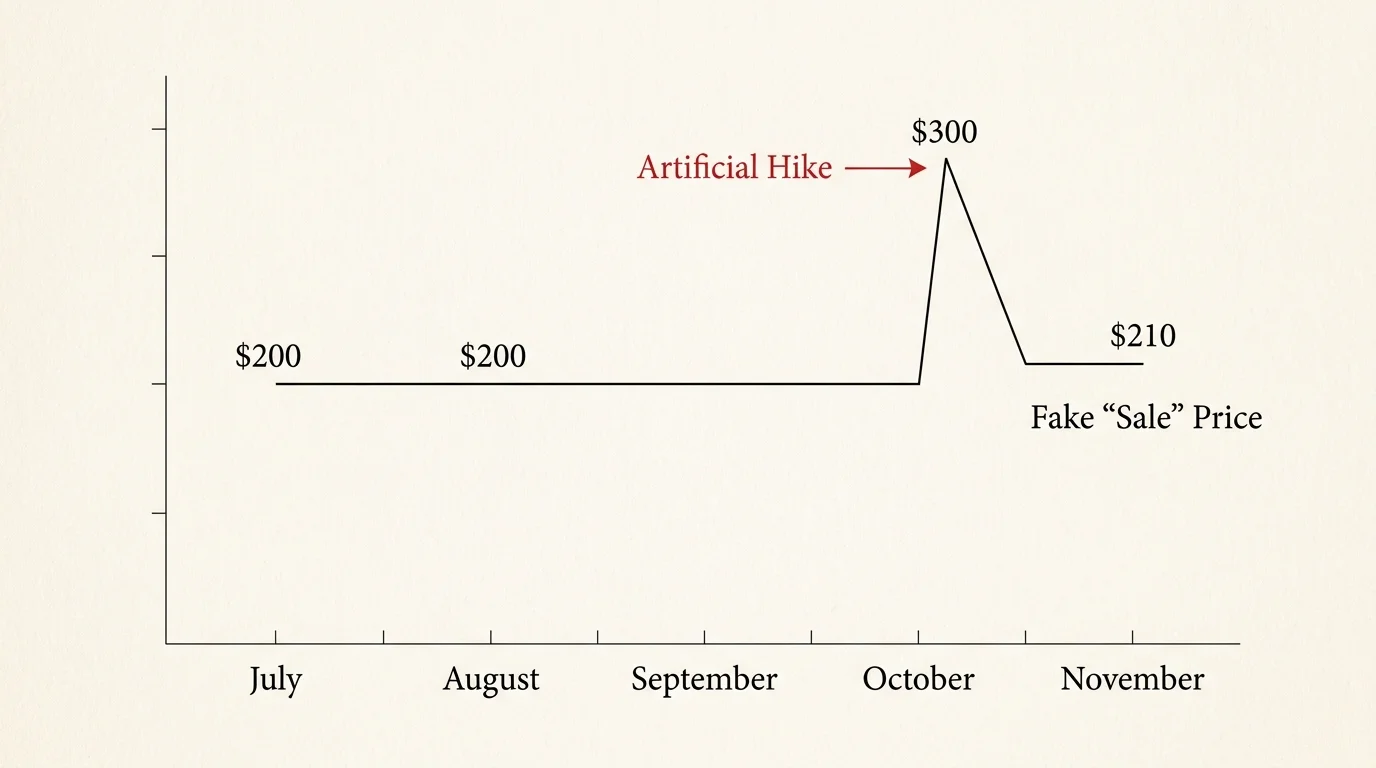
Never evaluate an advertised discount in isolation; always examine the item’s historical pricing trajectory over a ninety-to-one-hundred-eighty-day window. Free price-tracking browser extensions allow you to view interactive price history charts on major ecommerce platforms with a single click. When reviewing these graphs, focus on the thirty to sixty days immediately preceding major sales events. If a vacuum cleaner steadily sold for two hundred dollars all summer, jumped to three hundred dollars in early October, and then dropped to two hundred ten dollars for a holiday promotion, you are looking at a classic original price markup before discount rather than a genuine price cut.
2. Cross-Reference Universal Product Codes Across Competing Retailers
Merchants often inflate the suggested retail price on their proprietary storefronts because they assume shoppers will not bother to look elsewhere. You can instantly neutralize this trick by copying the exact Universal Product Code (UPC) or manufacturer model number from the product specifications and searching for it across multiple retail competitors. If three major retail chains list the standard selling price at one hundred fifty dollars while a fourth claims an original list price of two hundred fifty dollars marked down to one hundred sixty dollars, the promotional offer is completely fabricated. Independent comparisons dismantle retail price illusions in seconds.
3. Decode Physical Price Tags and Hidden Markdown Date Codes
Physical shelf tags and clearance stickers contain valuable data if you know how to interpret them. Many national department stores and warehouse clubs print subtle inventory codes directly on the corner of their price tags, including tiny date stamps that reveal when the store printed the label. If a clearance sticker displays a brand-new print date alongside a supposedly established regular price, the store likely raised the baseline price right before the promotional period. Furthermore, specific ending digits like ninety-seven cents or zero cents typically signify permanent clearance, while prices ending in ninety-nine cents usually denote standard full retail markup.
4. Scrutinize Comparative Price Terminology and Fine-Print Disclaimers
Carefully read the qualifying descriptive phrases retailers place next to strikethrough numbers. Under the FTC Guides Against Deceptive Pricing, an advertised former price must represent a bona fide price at which the merchant openly offered the item to the public for a reasonably substantial period. To sidestep this federal guidance, retailers frequently use ambiguous wording such as compare at, reference value, or estimated list price. These labels simply represent a hypothetical valuation or an outdated manufacturer suggestion that no merchant actively charges, signaling that the stated discount is largely imaginary.
5. Identify Promotional Derivative Models and Holiday-Specific SKUs
During high-volume sales cycles, electronics manufacturers regularly produce derivative models that look nearly identical to premium product lines but feature cheaper internal hardware. These units receive unique model numbers and carry inflated artificial list prices that were never charged in the open market. Check the alphanumeric model string carefully; if it contains unique regional letters or extra digits absent from the manufacturer’s flagship lineup, you are likely inspecting a promotional-only build. These derivative items often lack essential input ports, use inferior display panels, or omit premium components to protect retailer margins while mimicking higher-end gear.
6. Benchmark Against International Pricing Transparency Standards
If you shop with global retail brands that operate across international borders, you can leverage foreign consumer protection laws to verify pricing integrity. Under the European Union Omnibus Directive, merchants operating in EU member states must display the lowest price applied to a product during the previous thirty days as the mandatory baseline whenever they announce a price reduction. By viewing the European storefront of a global brand, you can observe this strictly regulated thirty-day baseline price, exposing whether the retailer artificially raised domestic baseline numbers to manufacture a steeper percentage discount for domestic consumers.
7. Measure Genuine Utility Cost-Per-Use Rather Than Stated Percentages
The most effective antidote to fictitious markdowns is shifting your financial mindset away from how much you save toward how much you actually spend. When a retailer claims an original price of four hundred dollars marked down to two hundred dollars, your household budget loses two hundred dollars of liquid cash—it does not gain two hundred dollars in wealth. Divide the final out-of-pocket cost by your projected number of uses over the item’s lifespan to calculate its genuine utility. If the real cost per use aligns with your family budget and daily needs, the purchase makes sense regardless of whether the advertised discount percentage is real or fabricated.

Action Lab: Conducting a Real-World Price History Audit
Let us walk through a practical scenario to see how you can audit a prospective deal before tapping your debit card. Imagine you are shopping for a mid-tier espresso machine that carries an advertised regular price of six hundred dollars, currently marked down by 35% to three hundred ninety dollars during a seasonal promotional campaign. Rather than reacting immediately to the red sale banner, you execute a quick three-step audit.
First, you copy the exact manufacturer model number and paste it into a price-tracking engine, revealing that the machine sold for three hundred seventy dollars for six consecutive months before spiking to six hundred dollars three weeks ago. Second, you cross-reference the model number on two competing retail sites and find both offering the exact machine at a standard everyday price of three hundred eighty dollars without any promotional banners. Third, you review your household cash flow and realize that buying this machine at the advertised sale price actually costs ten dollars more than its prevailing baseline value. By investing three minutes in this audit, you keep three hundred ninety dollars safely in your emergency fund.

Psychological Guardrails: Escaping the Anchoring Bias
Overcoming deceptive pricing tactics requires emotional discipline as much as technical tracking tools. Retail marketing departments deliberately engineer countdown clocks, low-stock warnings, and limited-time banners to induce artificial scarcity and rush your decision-making process. According to research from the Consumer Financial Protection Bureau, financial stress and manufactured urgency frequently impair consumer decision-making, leading households to take on unnecessary debt for non-essential purchases.
To protect your wallet, implement a mandatory twenty-four-hour cooling-off rule for any non-essential purchase exceeding fifty dollars. Stepping away from the screen breaks the psychological grip of the anchor price and neutralizes artificial urgency. Use that cooling period to review your monthly spending ledger and confirm that the purchase fits within your existing budget parameters. Remember that a fifty percent discount on an item you do not genuinely need is still a one hundred percent waste of your money.
Frequently Asked Questions About Retail Discount Tricks
Is it illegal for retail stores to inflate original prices right before a sale?
Under federal standards enforced by the Federal Trade Commission, advertising an inflated reference price solely to make a discount look larger is considered deceptive advertising. Additionally, several state statutes, such as California Business and Professions Code Section 17501, require that an advertised former price must have been the prevailing market price within the previous ninety days unless the merchant explicitly states when that price was charged. However, regulatory enforcement is challenging, so consumers must remain vigilant.
How can I identify whether an electronic item is a stripped-down derivative model?
Carefully compare the full model number against the manufacturer’s core product catalog. Derivative models created specifically for doorbuster sales typically have slight variations in their alphanumeric codes, such as extra letters at the end. You can also compare physical specifications, such as the number of HDMI ports, speaker wattage, or chassis materials, which manufacturers often downgrade to lower production costs for special promotional runs.
What is the difference between an MSRP and an advertised regular price?
The Manufacturer’s Suggested Retail Price is a non-binding baseline suggested by the producer, which many retailers rarely or never charge under normal market conditions. A regular or original price, by contrast, is legally supposed to reflect the actual price at which that specific retailer openly and routinely sold the item to the public for a substantial period. Retailers often display the MSRP as a strikethrough price to make their standard selling price look like a bargain.
Which retail categories have the highest frequency of fake original markups?
Mattresses, jewelry, home fitness equipment, and fast fashion consistently demonstrate the highest prevalence of artificial reference pricing. In these industries, items are almost perpetually marked down by 40% to 60%, meaning the baseline original price serves solely as a psychological anchor rather than a real market transaction figure.
Take Control of Your Household Shopping Cart
Smart money management is not about depriving yourself of the things your family enjoys; it is about ensuring that every dollar you spend delivers authentic value. Macroeconomic studies from the Federal Reserve consumer research division emphasize that proactive spending habits and price diligence provide substantial long-term protection against inflation and household financial strain. Tonight, pick one item currently resting in your online shopping cart or holiday wishlist and run it through a historical price tracker. Unmasking the real baseline cost behind that shiny discount badge puts you firmly in control of your financial destiny.