Saving fifteen percent at checkout feels like an immediate financial victory, but signing up for a store credit card often costs you far more than you save. Retailers pitch these instant discounts at the cash register to lock you into high-interest debt that quietly drains your monthly budget. While a one-time price reduction looks enticing when you want to stretch your hard-earned paycheck, astronomical interest rates and restrictive terms can quickly turn a quick discount into a prolonged financial headache. Before you accept an offer to open a new account to save twenty dollars today, you need to understand the hidden mechanics that make most store cards a losing financial gamble.
The Real Cost Behind Register Promotions
Standing in a crowded checkout line after a long workweek, an offer to shave twenty or thirty dollars off your total sounds like effortless savings. Retailers design checkout promotions to catch you when decision fatigue is at its peak; your arms are full, the register line is moving, and the immediate reward of a smaller receipt total feels irresistible. However, retail store cards represent some of the most predatory and expensive borrowing tools available in consumer finance today.
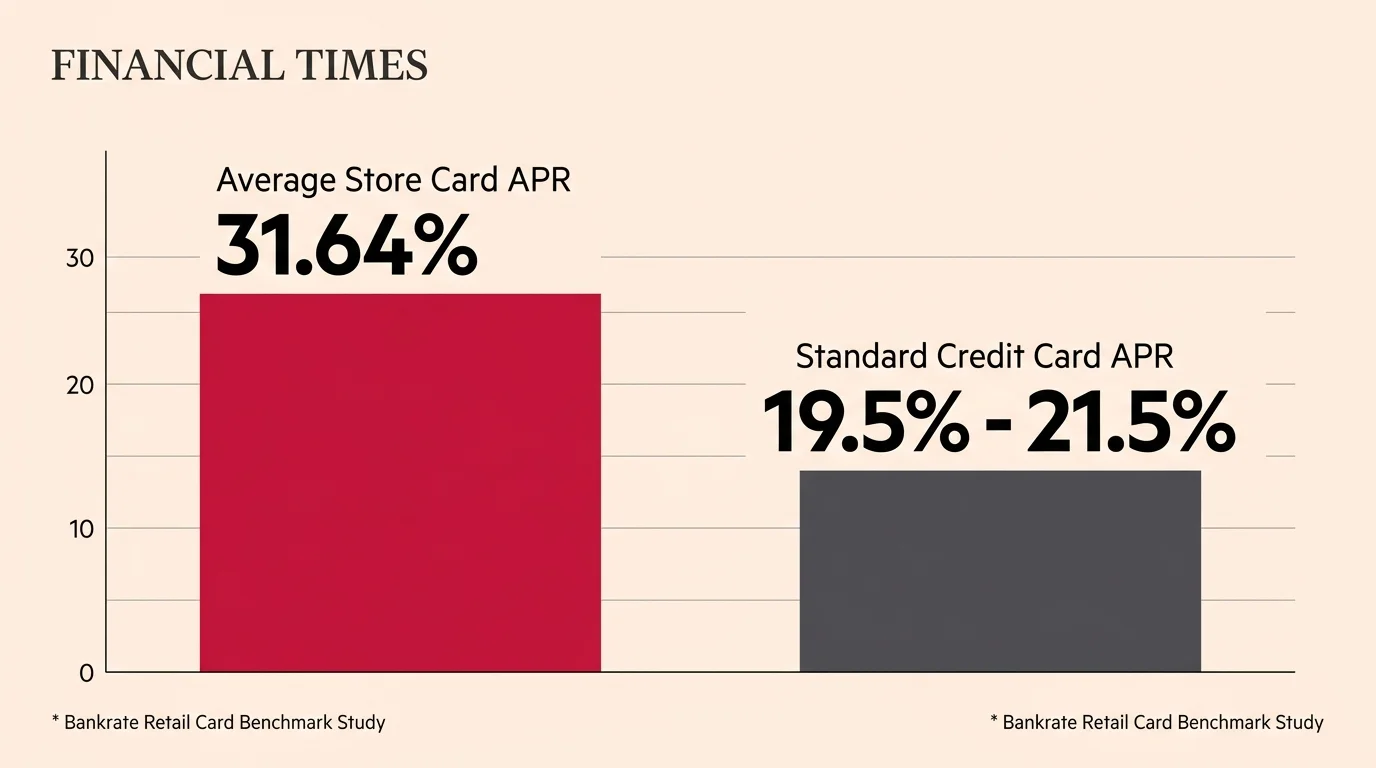
According to a comprehensive Bankrate retail card benchmark study, the average annual percentage rate on store credit cards sits between 30.14% and 30.58%, with store-only closed-loop cards averaging 31.64% and several major retail cards capping out at an astonishing 35.99%. In sharp contrast, standard general-purpose credit cards carry average interest rates between 19.5% and 21.5%, establishing an eight to eleven percentage point interest penalty on retail cards. While recent Federal Reserve consumer credit data highlights expanding household debt balances nationwide, retail cardholders face the steepest financing costs on the market.
The financial danger multiplies when you evaluate actual consumer repayment patterns. A detailed Consumer Financial Protection Bureau report found that 54% of private-label retail cardholders carry balances from month to month, compared to 48% of general credit cardholders. Furthermore, 17% of store card users make only the minimum monthly payment. Most shoppers do not pay off their promotional purchases immediately; instead, they carry high-interest balances forward, rapidly turning an initial register discount into compounding debt.

8 Clear Signs to Skip the Retail Credit Card
Store cards are rarely the cost-saving tools advertised at the register. If you encounter any of the following eight warning signs, decline the offer immediately and protect your household cash flow.
1. You Plan to Carry Any Balance Past the First Statement
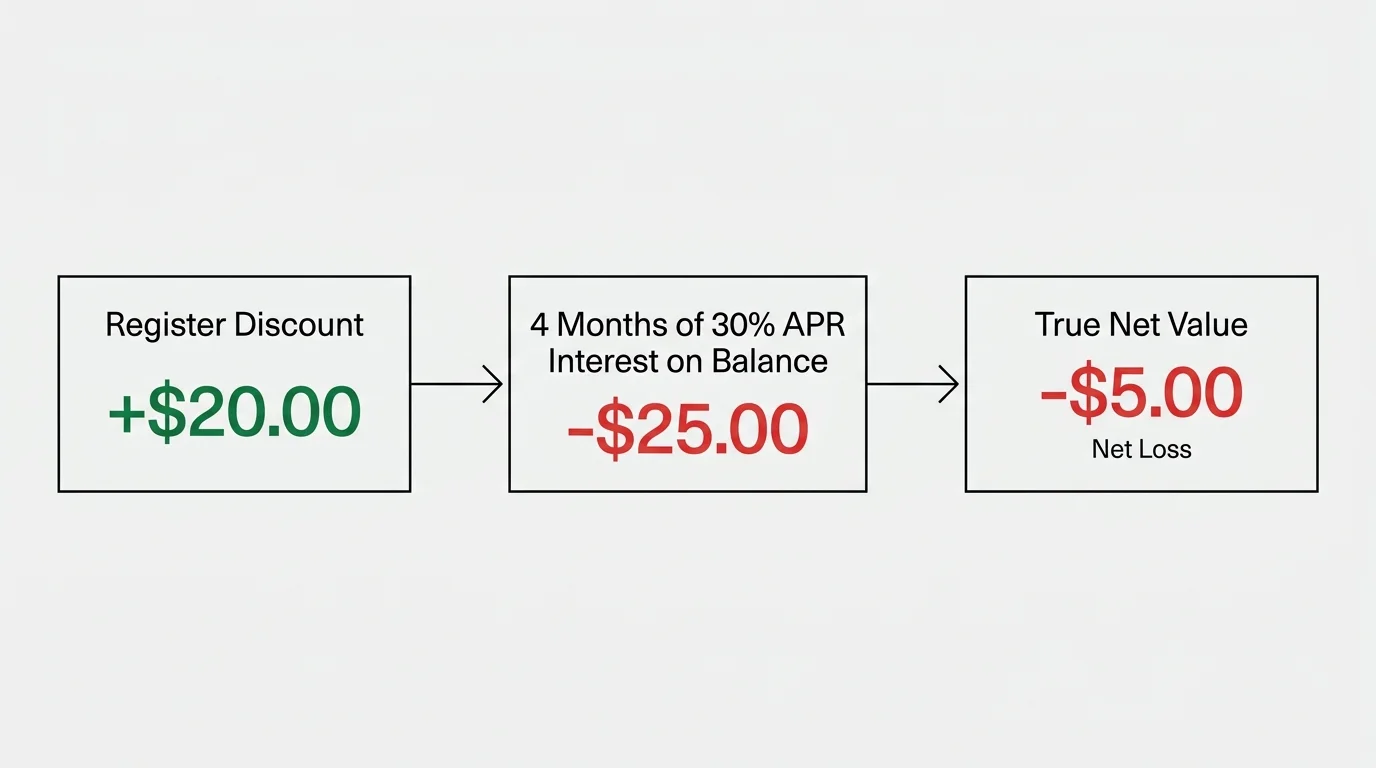
If you cannot pay off your full balance on the very first billing statement, the register discount becomes an expensive financial error. Retailers typically offer a 10% to 20% discount on your initial purchase to entice you to apply. However, with store card APRs averaging above 30%, carrying a balance for just three to four months completely erases your original savings. After month four, you are paying pure interest on merchandise that has already lost its novelty, turning a temporary bargain into a prolonged monthly drain.
2. The Offer Relies on Deferred Interest Financing
Many major retailers advertise zero-interest promotions for six, twelve, or twenty-four months on furniture, electronics, or appliances. Under federal credit guidelines, these deals frequently contain deferred interest clauses rather than true 0% APR terms. If you fail to repay the entire balance before the promotional window closes—even if you leave just five dollars unpaid—the lender retroactively applies full interest charges across the original purchase price dating back to the transaction date. A minor lingering balance can trigger hundreds of dollars in surprise interest charges.
3. The Card Issues a Fragile, Low Credit Limit
Retail lenders routinely assign low starting credit limits between $300 and $500 to protect their own financial exposure. While a low limit might seem safe, it poses a direct hazard to your credit score. The official FICO credit scoring breakdown assigns 30% of your credit score to your credit utilization ratio. Charging a $250 purchase on a card with a $300 limit spikes your utilization to 83%, easily surpassing the recommended 30% threshold and pulling down your credit score.
4. You Are Shopping Under Register Pressure or Emotional Fatigue
Retail cashiers undergo specific training to pitch credit applications during the final moments of checkout, when your cognitive resistance is lowest. Behavioral economists emphasize that shoppers under time pressure or mental exhaustion tend to overestimate the benefit of an instant discount while ignoring future borrowing costs. If you feel rushed by a line of waiting customers, embarrassed to hold up the register, or mentally fatigued from shopping, you should never make an on-the-spot borrowing commitment.
5. The Card Is Closed-Loop and Restricts Your Purchasing Freedom
Closed-loop store cards only work at the specific retail chain where you applied. Unlike flexible cash-back cards, closed-loop accounts reward you with proprietary store vouchers that carry strict expiration dates and minimum purchase thresholds. These vouchers force you to return to the store and make additional purchases simply to redeem your rewards. This dynamic creates manufactured spending on items you never intended to buy, locking your household cash flow into a perpetual retail spending cycle.
6. You Plan to Apply for a Major Loan Within Six Months
Every store credit card application generates a hard inquiry on your credit report. Data from LendingTree credit research confirms that a hard inquiry can lower your credit score by up to five points for two years. If you plan to apply for a mortgage, an auto loan, or a primary line of credit in the near future, an unnecessary hard inquiry combined with a newly opened retail account can elevate your risk profile and increase your borrowing rates on major life purchases.
7. The Rewards Program Imposes Complex Spending Thresholds
Retail loyalty programs often disguise low reward values behind confusing point systems and tiered spending requirements. You might need to spend $500 to earn a $20 reward voucher loaded with blackout dates and category exclusions. When calculated mathematically, the effective return on your spending rarely exceeds two percent. Tying your spending habits to a narrow, restrictive reward catalog adds unnecessary administrative hassle while delivering minimal financial benefit compared to simple cash-back programs.
8. Your General Rewards Card Already Beats the Net Value
Most savvy consumers already carry a standard cash-back credit card that pays 1.5% to 2% cash rewards on every purchase across all categories. When you consider direct statement credits, lower standard interest rates, and total spending flexibility, store cards rarely provide competitive value. A dependable general rewards card delivers steady cash returns across your entire budget without restricting your purchasing power to a single retail brand or subjecting you to punitive interest rates.

Strategic Cash-Flow Alternatives That Build Real Wealth
Instead of relying on checkout discounts to trim household expenses, you can build sustainable savings through intentional financial systems. Start by conducting a monthly cash-flow audit across your bank statements. When you review recurring expenditures and eliminate unused subscriptions, you recover real dollars that remain in your checking account rather than chasing conditional store coupons.
A second foundational strategy involves creating dedicated sinking funds for predictable retail expenses. Whether you budget for seasonal clothing, holiday shopping, or home upgrades, automating a weekly transfer of $25 into a high-yield savings account ensures cash is ready before you reach the register. Paying with accumulated savings eliminates interest costs completely and keeps you in total control of your money.
Finally, implement a mandatory 48-hour cooling-off rule for non-essential retail purchases over fifty dollars. Retailers design checkout discounts to capture impulsive purchases before you have time to evaluate alternatives. Giving yourself two days to reflect interrupts the emotional buying cycle, gives you time to compare competitor prices, and ensures every purchase aligns with your family priorities.
Action Lab: Calculating the True Cost of a Store Card Discount
To see how store card interest quietly destroys register savings, consider a realistic shopping scenario. Imagine you purchase $300 worth of clothing and household goods. The cashier offers a 15% discount for opening a store card, instantly saving you $45 and leaving a remaining balance of $255 on the new account.
If you carry that $255 balance on a card with a 31.64% APR and make a modest monthly payment of $25, clearing the balance will take twelve months and cost approximately $47 in accumulated interest charges. That $47 interest expense completely erases your initial $45 discount and leaves you paying more than the original price of the items. If you only make the minimum monthly payment, your interest costs will double, transforming an apparent bargain into an expensive financial headache.

Retail Pitfalls and Smarter Guardrails
Protecting your household budget requires clear personal boundaries before you reach the checkout counter. Prepare a simple refusal phrase in advance; saying “No thank you, I am paying with my designated spending account today” allows you to decline store card pitches quickly and confidently without awkward hesitation.
If you already opened a store credit card in the past and currently hold a zero balance, avoid closing the account abruptly if it charges no annual fee. Keeping the account open preserves your average length of credit history and supports your total available credit limit. Simply remove the physical card from your wallet, store it in a secure drawer, and ensure no recurring charges are active.
Frequently Asked Questions
Does declining a store credit card offer hurt my credit score?
Declining an offer at the register has zero impact on your credit score. A credit inquiry occurs only when you provide your Social Security number and sign an official credit application.
What should I do if I currently carry an active store card balance?
Prioritize paying off your high-interest store card balance as quickly as possible. Direct extra monthly funds toward the retail balance while making minimum payments on lower-rate debt, or consider a 0% APR balance transfer card to pause interest charges while you pay down the principal.
Can a retail store card ever be a smart financial tool?
A store card can provide net value only if you shop at that specific retailer frequently, the card provides substantial ongoing discounts rather than just a one-time sign-up discount, and you pay 100% of the statement balance in full before every due date.
Why do retail associates push store credit cards so aggressively?
Retail corporations pressure store associates to meet weekly credit application quotas because retail credit programs generate massive profit margins through financing fees and increased customer spending. Companies often tie employee performance reviews, hourly bonuses, and scheduling privileges directly to credit card application numbers.
Take Control of Your Register Decisions
True financial progress comes from building intentional spending habits rather than chasing small discounts at the cash register. The next time a cashier offers an instant percentage off your purchase in exchange for a credit application, recognize the offer for what it truly is: an expensive financing tool designed to generate corporate profits from revolving consumer debt.
Rely on your structured household budget, make purchases with dependable cash-back cards, and fund your lifestyle through disciplined cash planning. Every time you decline an unnecessary store credit card, you protect your credit score, eliminate interest charges, and keep your household budget moving forward on your own terms.