
Generating local side income transforms your community into a reliable engine for financial growth, helping you stretch your paycheck without commuting or sacrificing your quality of life. Tapping into the local demand right outside your front door offers an immediate path to generating cash flow that digital gigs simply cannot match. You already know the rhythms of your neighborhood, the specific services people struggle to find, and the underutilized spaces in your own home. By leveraging this geographical advantage, you can build profitable ventures rooted in community trust. Earning extra money does not require competing on global freelance platforms; it simply requires recognizing the localized gaps you are uniquely positioned to fill.

The State of the Wallet: Why Local Side Hustles Matter Now
Middle-income households currently face a unique financial squeeze. While headline inflation metrics may occasionally cool down, the everyday reality at the grocery checkout and the gas pump tells a different story. Your primary paycheck likely covers your baseline living expenses, but the margin for discretionary spending, emergency savings, and retirement investments has undeniably shrunk over the past few years. When the cost of living outpaces wage growth, relying solely on your primary salary limits your financial flexibility and leaves you vulnerable to sudden economic shifts.
To bridge this gap, many people turn to the internet, hoping to strike gold on massive freelance platforms. Unfortunately, the digital gig economy is saturated. You end up competing against millions of other people across the globe, driving down the hourly rate you can command for your skills. This race to the bottom often leads to burnout and frustration, yielding pennies for hours of hard work.
The antidote to global digital competition is hyper-local physical action. According to recent surveys on household economic well-being, a significant percentage of adults now rely on supplemental income to meet their financial goals. However, those who provide in-person, localized services often command higher premiums because they offer convenience and trust—two commodities that cannot be easily outsourced or automated. Your geographic proximity to your neighbors is a distinct competitive advantage. When you pivot your focus from the digital world to your physical community, you bypass the algorithm and tap directly into a market that values reliability, familiarity, and a friendly face.
Strategy Pillars: Capitalizing on Your Community
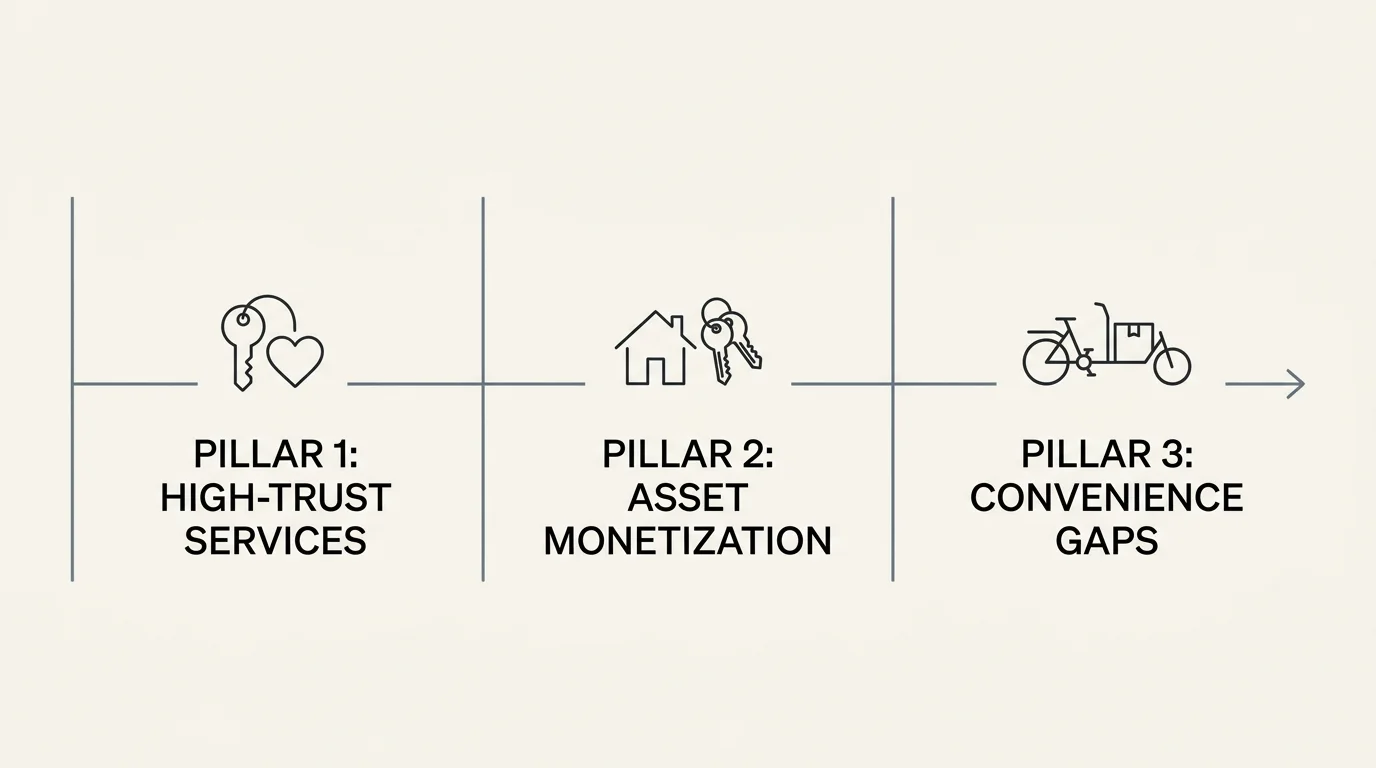
Transforming your town into a source of extra income requires a strategic approach to the assets and skills you already possess. Rather than throwing random ideas at the wall, you can categorize local opportunities into three core strategy pillars. These pillars focus on providing high-trust services, monetizing the assets you already own, and bridging gaps in local convenience. By understanding these frameworks, you can select the specific side income ideas that best fit your lifestyle and your neighborhood’s unique demands.
Pillar One: Providing High-Trust Local Services
Trust is the most valuable currency in any local economy. People are highly protective of their homes, their children, and their pets. When they need help in these areas, they strongly prefer hiring a vetted neighbor over a stranger dispatched by a corporate app. If you can establish yourself as a dependable, responsible member of the community, you can command premium rates for services that require a high degree of personal trust.
Idea 1: Premium Pet Care and Boarding
Pet ownership soared over the past decade, and working professionals are constantly seeking reliable care for their animals. While massive pet-sitting apps take a hefty percentage of your earnings and force you to compete on price, marketing your services directly to your neighborhood allows you to keep the entire fee. You can offer mid-day dog walking for neighbors commuting to the office, or provide overnight boarding in your own home for families going on vacation. Because you live nearby, clients feel secure knowing you can respond quickly to emergencies. Once you secure two or three regular clients through local community boards or neighborhood word-of-mouth, this side hustle provides highly predictable, recurring revenue that can easily cover a monthly utility bill or boost your savings rate.
Idea 2: Specialized Home Maintenance and Handyman Tasks
Many homeowners lack the time, tools, or physical ability to handle routine property maintenance. Tasks like cleaning gutters, power washing driveways, assembling flat-pack furniture, or winterizing sprinkler systems represent massive pain points for your neighbors. You do not necessarily need to be a licensed general contractor to perform these basic tasks—you just need a strong work ethic and attention to detail. By positioning yourself as the neighborhood’s go-to problem solver, you establish a pipeline of seasonal work. You can charge a flat rate per project or an hourly fee, and because your travel time is virtually zero, your profit margins remain exceptionally high.
Idea 3: Hyper-Local Academic Tutoring and Coaching
Parents invest heavily in their children’s education, and the demand for in-person tutoring remains incredibly strong. If you possess a college degree, a background in education, or specialized knowledge in subjects like advanced mathematics, chemistry, or SAT preparation, you hold a highly marketable local skill. Conducting tutoring sessions at the local library or right at your kitchen table offers a distraction-free environment for students. Furthermore, by understanding the specific curriculum of your local school district, you provide tailored, highly relevant support that generic online tutoring platforms simply cannot match. This side income idea scales beautifully; you can start with just one student on a Saturday morning and expand your roster as your reputation for delivering academic results grows throughout the community.
Pillar Two: Renting Out Underutilized Assets
If your schedule is already packed with a full-time job and family obligations, trading more time for money might not be feasible. Instead, you can look at the physical assets you already own and rent them out to neighbors who need temporary access to them. This strategy generates extra income with minimal active effort, turning your dormant property into a passive revenue stream.
Idea 4: Renting Storage Space and Parking Spots
Space is a premium commodity, especially in suburban areas where homeowners accumulate boats, recreational vehicles, and excessive household goods. If you have an empty bay in your garage, a spacious shed, or an unused paved area beside your home, you can lease that space to neighbors. Commercial storage facilities frequently raise their rates, making a private, secure neighborhood arrangement highly attractive to budget-conscious consumers. You can draft a simple rental agreement, collect a monthly fee, and essentially earn money just by allowing a neighbor’s pop-up camper to sit on your unused gravel pad.
Idea 5: Loaning Specialized Equipment to Neighbors
Think about the specialized tools gathering dust in your garage right now. Extension ladders, heavy-duty carpet cleaners, rototillers, and professional-grade pressure washers are expensive items that people typically only need once or twice a year. Instead of your neighbors traveling to a big-box hardware store to rent these tools at exorbitant daily rates, you can rent your own equipment directly to them. By charging a fraction of the commercial rental price and requiring a modest security deposit, you help your community save money while generating a solid return on the initial investment you made in those tools.
Pillar Three: Bridging Local Retail and Convenience Gaps
Even in well-connected towns, gaps in convenience exist. People are busier than ever, and they are willing to pay for services that return precious hours to their week. By identifying the friction points in your neighbors’ daily routines, you can offer solutions that make their lives easier while padding your own bank account.
Idea 6: Hyper-Local Errand Running and Senior Assistance
Many towns have a growing demographic of elderly residents who wish to age in place but struggle with the physical demands of running household errands. Offering a personalized errand service—picking up heavy bags of dog food, fetching prescriptions, doing the weekly grocery shopping, or transporting yard waste to the local dump—provides immense value. Unlike large delivery apps that leave groceries on the curb, you can offer a premium, white-glove service that includes bringing items inside and putting them away. This builds deep loyalty and often results in generous tips, alongside the baseline fee you charge for your time.
Idea 7: Seasonal Yard Resiliency and Preparation
Beyond basic lawn mowing, properties require significant seasonal transitions. In the late autumn, garden beds need to be cleared, delicate shrubs must be wrapped, and mountains of leaves require raking and bagging. In the spring, heavy bags of mulch must be hauled and spread. By offering specialized seasonal yard preparation packages, you catch homeowners right when they feel overwhelmed by impending weather changes. You can distribute flyers in your immediate area outlining a flat-fee “Winter Readiness Package” or a “Spring Revival Service,” allowing you to batch your work over a few weekends and secure a large influx of cash right when you need it for holiday shopping or summer vacation funds.

Real-World Voices: Insights from Financial Planners
Financial planners continually emphasize the psychological benefits of diversifying your income streams. When you rely exclusively on one employer, any disruption to that job creates immediate financial trauma. Building a secondary income stream locally acts as an essential shock absorber for your household budget. Experts in behavioral economics also note that local side hustles offer unique motivational advantages. When you work directly with your neighbors, you build community social capital. The immediate positive feedback and gratitude you receive from a neighbor whose house you just power washed is vastly more fulfilling than completing a faceless data-entry task online.
Moreover, managing this extra money correctly is critical to actually getting ahead. Planners strongly suggest keeping your side income strictly separated from your primary checking account. Institutions frequently highlight the importance of managing irregular or variable income carefully to avoid accidental lifestyle creep. By sweeping your local earnings directly into a dedicated high-yield savings account or using them to aggressively pay down high-interest debt, you ensure that your weekend labor translates into permanent wealth rather than temporary consumption.
Action Lab: Calculating Your Local Earning Potential
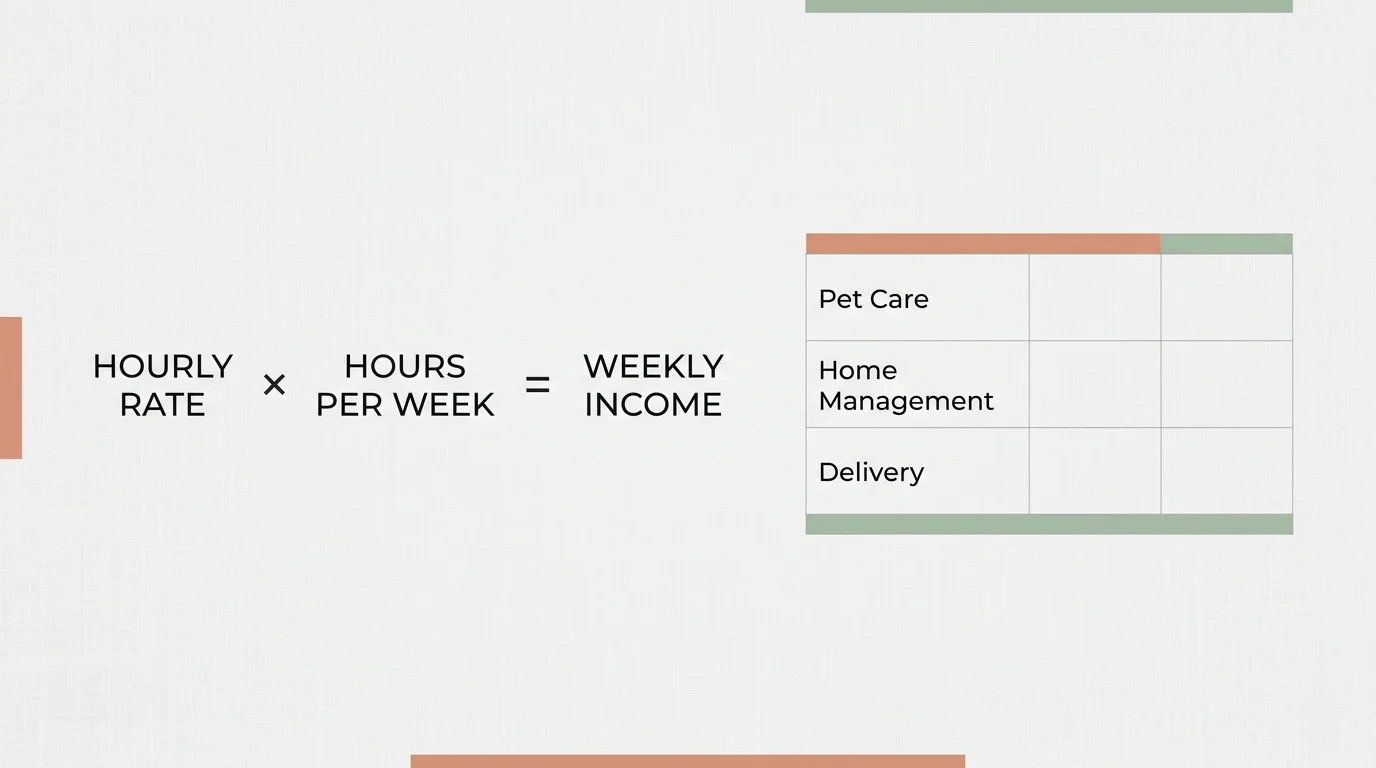
To turn these concepts into reality, you must define exactly what your financial goal is and reverse-engineer the math to achieve it. Vague goals like “making more money” rarely lead to sustained action. Let us walk through a concrete calculation to demonstrate how a local service can fund a specific financial objective.
Suppose you want to fully fund an Individual Retirement Account (IRA) this year, which requires contributing approximately $583 per month. You decide to pursue Idea 1: Premium Pet Care. First, research the going rate for a 30-minute dog walk in your specific zip code; for this example, we will assume it is $25. To hit your goal of $583, you need to conduct roughly 24 walks per month.
If you secure just two neighbors who need their dogs walked three days a week while they are at the office, you have committed to 24 walks a month (2 dogs, 3 days a week, 4 weeks a month). This requires just three hours of your time per week—time you might spend exercising anyway. By formalizing this local arrangement, you successfully fund your retirement account entirely through side income, effectively freeing up your primary paycheck for current living expenses. This is the power of targeted, local action.

Guardrails and Pitfalls: Avoiding Common Side Hustle Traps
While local side income is highly accessible, it is not without risks. The most common mistake new gig workers make is dramatically underpricing their services. When you factor in your time, the wear and tear on your vehicle, and the cost of any supplies, charging too little will quickly lead to resentment and burnout. Always research the commercial rate for your service locally, and price yourself competitively but fairly; your neighbors are paying for convenience and trust, not a discount bin experience.
Another major pitfall involves ignoring the legal and tax implications of your new revenue stream. Even if you are just earning cash by cleaning gutters in your neighborhood, the government still considers that taxable income. Failing to set aside a portion of your earnings for quarterly taxes can result in a painful surprise during tax season. It is essential to consult the guidelines for gig economy workers to understand your reporting requirements. Furthermore, if you are performing physical labor or bringing client pets into your home, you must verify that your homeowner’s insurance policy covers these activities, or you may need to purchase a modest liability policy to protect your assets.
Frequently Asked Questions
How much money can I realistically make from local side jobs?
Your earning potential is directly tied to the number of hours you are willing to commit and the specific service you provide. Simple tasks like dog walking might yield an extra $300 to $500 a month with minimal time investment. However, specialized services like academic tutoring, seasonal landscaping packages, or professional home organization can easily generate over $1,000 a month if you dedicate your weekends to them. The key is to start small, validate the local demand, and steadily increase your rates as your neighborhood reputation solidifies.
Do I need a formal business entity to start earning extra income?
In most local jurisdictions, you can operate simply as a sole proprietor under your own name without needing to file complicated paperwork for a Limited Liability Company (LLC) right out of the gate. However, if your side hustle scales significantly, involves substantial physical risks—such as heavy machinery operation or major home repairs—or requires you to hire employees, forming an LLC is strongly recommended to protect your personal assets. Always check your specific municipal regulations regarding local business licenses and home-based business zoning laws before launching a large-scale operation.
How do I handle taxes for neighborhood-based services?
All income earned from your local side hustles must be reported on your annual tax return, regardless of whether you are paid in cash, through mobile payment apps, or via personal checks. Because an employer is not withholding taxes from these earnings, you are personally responsible for both income tax and self-employment tax. A best practice is to automatically transfer 25 to 30 percent of every payment you receive into a separate, untouched savings account dedicated exclusively to your future tax liabilities.
What is the best way to market myself within my own town?
The most effective local marketing strategies rely on leveraging existing community trust networks. You can start by posting a clear, friendly description of your services in hyper-local Facebook groups or on neighborhood-specific apps like Nextdoor. Physical marketing still works incredibly well in this context; designing a simple, professional flyer and dropping it in your neighbors’ mailboxes or pinning it to the bulletin board at your local coffee shop or community center puts your name directly in front of the people who live closest to you. Always encourage your first few clients to spread the word, as personal referrals remain the absolute strongest driver of local business.
Your Next Steps
Stretching your household income does not require you to radically alter your career trajectory or spend your evenings scrolling through dubious online job boards. The most reliable and profitable opportunities are often located within a two-mile radius of your living room. By taking a careful inventory of your skills, analyzing your unused assets, and observing the everyday frustrations of your neighbors, you can build a resilient secondary income stream that immediately improves your financial standing. Pick just one of the strategy pillars outlined above this week. Have a conversation with a neighbor, draft a simple service flyer, or clear out that empty garage bay. Taking deliberate, local action today lays the foundation for a much more comfortable and secure financial tomorrow.